Do AI fashion photos actually look real in 2026?
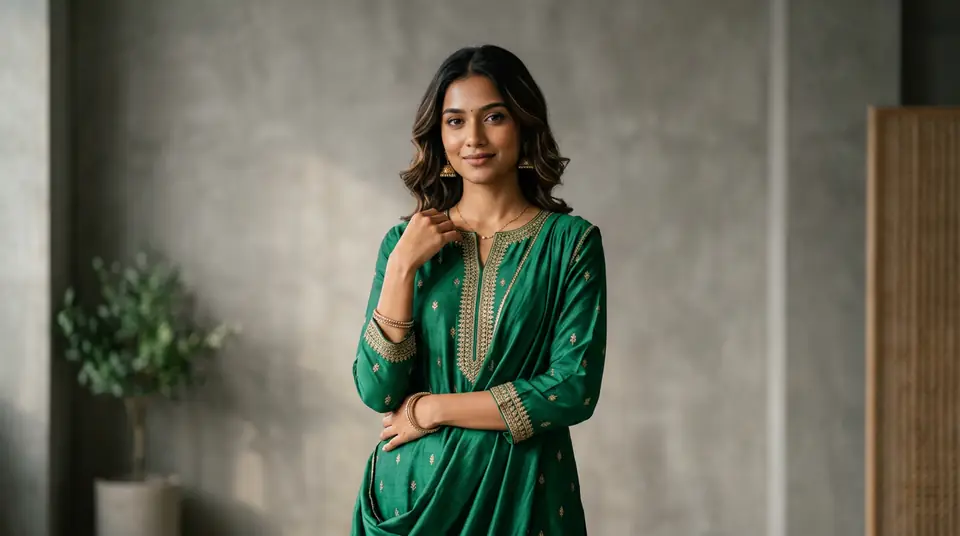
Yes, absolutely they do. Let's get that out of the way upfront. The era of stiff, uncanny valley AI models and bizarre fabric drapes? That's ancient history in the fast-moving world of artificial intelligence. Today, high-quality AI fashion photography, when done right, is virtually indistinguishable from what you'd get from a traditional studio photoshoot.
I’ve spent two decades behind a camera, wrestling with light, fabric, and reluctant models in Mumbai’s humid studios. I know a 'real' photo when I see one. And what AI systems are putting out now? They're sharp, the lighting is spot-on, and crucially, the fabric — be it silk, georgette, or heavy cotton — drapes realistically. You see the natural folds, the shadows. It’s not just about generating an image; it's about simulating physics.
How do AI photos become indistinguishable from real ones?
They become indistinguishable because modern AI photography platforms aren't just 'drawing' images; they're learning from vast datasets of real-world photos and applying sophisticated algorithms to understand light, texture, and human form in 3D space. Think of it like a digital sculptor who has seen every human body, every fabric type, every lighting condition imaginable.
When you upload a single photo of your kurti on a hanger, the AI doesn't just put it on a model. It deconstructs that garment into its digital components: fabric texture, cut, seams. Then, it places this digital garment onto a 3D model, simulates the interaction of light from a chosen environment, and renders it. The results are high-resolution outputs, often in 1K, 2K, or even 4K, that stand up to close scrutiny on Myntra or Amazon India listings. The details matter, from the subtle sheen on a silk saree to the intricate embroidery on a lehenga.
“The magic isn't just in making a 'pretty picture'. It's in making a picture that *feels* right, that tricks the eye into believing it's a moment captured, not created.”
Can AI models really look like *my* customers?
Yes, AI models can absolutely represent your customer base, and often with greater precision and diversity than traditional methods allow. One of the biggest challenges for Indian brands has always been finding models that truly reflect the incredible regional and ethnic diversity of our consumers. A customer in Chennai wants to see someone who looks like them, just as much as a customer in Kolkata or Amritsar.
With platforms like DrapifyApp, you can select from a wide range of AI models. These aren't just generic faces; they're designed to represent various Indian skin tones, body types, and features. You can even lock in an 'identity' for a specific model, ensuring consistency across all your shots for a collection. This means your customer searching for a bridal lehenga for the upcoming wedding season can see it on a model that resonates with them, building trust and connection.
Generate your own AI fashion photoshoot with Drapify — 50 free credits, no card required.
Will AI save me money on fashion photoshoots in India?
Significantly, yes, it will. This isn't just about saving a few rupees; it's about transforming your entire budget allocation for visuals. Think about a typical studio photoshoot day in Delhi or Mumbai. You're looking at a studio rental, photographer fees, stylist, makeup artist, models, assistants, travel, catering, and then post-production. A modest day can easily run you ₹40,000-₹70,000, and that's before you factor in individual garment shots. If you need 50 unique catalogue images, that cost per photo skyrockets.
₹48,000
Average studio day rate (basic)
₹15,000
Average model day rate (mid-range)
₹13-15
DrapifyApp cost per AI photo
24 hours
Typical turnaround for physical shoot edits
Compare that to AI solutions. With DrapifyApp, for instance, you're paying around ₹13-15 per photo. No studio. No models. No MUA. No travel. You literally take a picture of your garment on a hanger with your phone, upload it, pick a model and pose, and get a professional image in roughly 3 minutes. If a shot doesn't quite work, they often have an auto-refund policy. This makes high-volume catalogue creation incredibly affordable, freeing up capital for marketing or inventory.
What about getting different poses or colours for my collection?
It's far easier and quicker than traditional methods, removing major bottlenecks for multi-variant SKUs. Imagine you sell a beautiful silk kurti that comes in six different colours: indigo, emerald, ruby, mustard, coral, and charcoal. Traditionally, you’d either have to shoot each colour individually, which is expensive and time-consuming, or just show two colours and hope customers imagine the rest. That hope costs you sales.
Is AI just for big brands, or can my small boutique use it too?
Absolutely not. AI fashion photography is designed to democratize access to high-quality visuals, making it perfect for small boutiques, Etsy sellers, and emerging designers across India. The entry barrier is incredibly low. You don't need expensive equipment, a team of professionals, or even a dedicated studio space.
I’ve seen boutique owners in Goa creating stunning catalogues for their beachwear collections, and artisan saree weavers in Kanchipuram finally showcasing their intricate designs on diverse models. Many platforms, like DrapifyApp, even offer free credits to start (often 50 free credits!), letting you test the waters without any upfront investment. Your credits usually don't expire either, so you can build your catalogue at your own pace. This levels the playing field, allowing smaller players to compete visually with established brands on platforms like Flipkart and Myntra.