Who This Guide Is For (And What We're Comparing)
This breakdown is for any Indian apparel brand owner, big or small, who sells both on their own Direct-to-Consumer (DTC) website—think Shopify or Woocommerce—and on major Indian marketplaces like Myntra, Ajio, or Amazon India. We are comparing two distinct approaches to your product photos: the highly standardized, rule-bound world of marketplace photography versus the creative, brand-building world of DTC photography. The goal isn't to say one is better, but to show you they have different jobs. Using one for the other's job is like sending a Test batsman to play a T20 slog-over. Possible, but not optimal.
My family has been in the Surat textile trade for over 60 years. When we moved online, we made this exact mistake. We put our fancy, location-shot saree photos on Amazon, and they got rejected. We put our boring, white-background kurti photos on our own site, and they just sat there. Learning the difference changed our business.
Marketplace vs. DTC Photography: A Side-by-Side Comparison
| Criterion | Marketplace Photography (Myntra, Ajio, Amazon) | DTC Photography (Your Own Shopify/Website) |
|---|---|---|
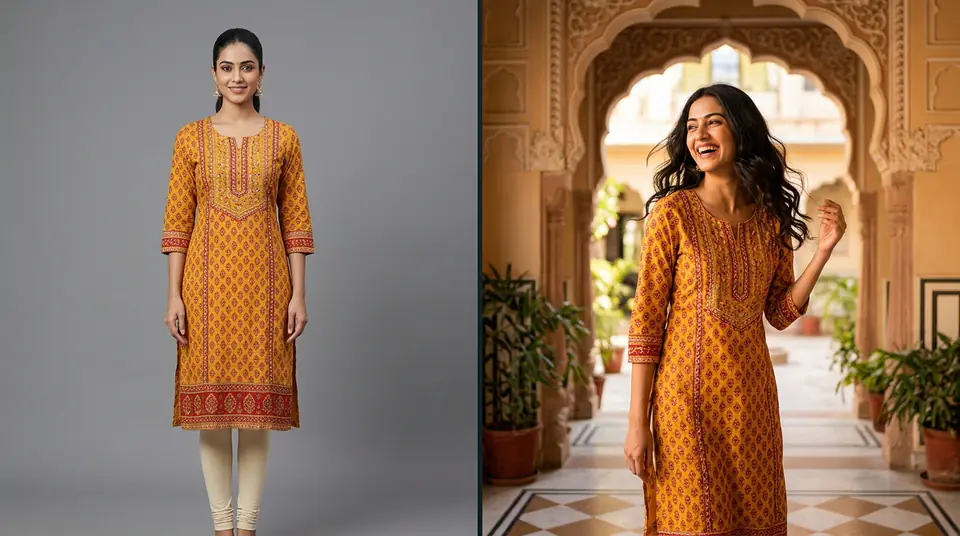
| Primary Goal | Compliance & Comparison. Fit the platform's template so customers can easily compare your product with a competitor's. | Brand Storytelling & Desire. Create an emotional connection and a premium experience that justifies your price. |
| Background | Strictly mandated. Usually light grey (#F6F6F6) or pure white. No props, no scenery. Zero exceptions. | Branded & Contextual. Lifestyle settings, coloured backdrops, props, interesting shadows. Whatever tells your brand's story. |
| Model Posing | Standardized, product-first poses. Front view, side view, back view, 45-degree angle. Minimal emotion, maximum clarity. | Dynamic, editorial, and aspirational. Models can laugh, move, interact with the environment. It's about selling a mood. |
| Styling | Minimalist. The focus is 100% on the product being sold. No distracting accessories unless they are part of a set. | Layered & Aspirational. Styled with other products (yours or others), unique accessories, and creative hair/makeup to build a 'look'. |
| Shot Variety | Prescribed list of 5-7 shots per SKU. E.g., full length, waist-up, detail of fabric, detail of embroidery, back. | Unlimited. Creative close-ups, shots showing movement, behind-the-scenes content, user-generated-content style shots. |
| Technical Specs | Rigid requirements for resolution (e.g., 1080x1350px), file size (<1MB), and aspect ratio. Fail, and your listing is rejected. | Flexible. You choose what works for your site design. Often higher resolution for better zoom. Supports vertical video, GIFs. |
| Cost per SKU | Lower. ₹800 - ₹2,000 in a city like Surat or Jaipur for a standard 5-photo set. It's a volume game. | Higher. ₹3,000 - ₹10,000+ per SKU. Involves location scouting, stylist fees, and more creative direction. |
Deep Dive: The Background & Styling Battleground
The single biggest difference between marketplace and DTC photography is the background. Marketplaces enforce a uniform background so that when a customer searches for 'blue printed kurti', she sees a grid of twenty kurtis that are easy to compare on design and price, not on the fancy hotel lobby you shot it in. Myntra is famously strict about this, requiring a specific off-white or light grey background. This non-negotiable rule is the great equalizer. It’s all about the product, stripped of context.
On your own DTC site, however, that context is everything. That hotel lobby, or a beautiful Jaipur courtyard, tells a story. It suggests a lifestyle, a certain level of quality, and helps you justify a higher price than the guy selling a similar kurti on Amazon. Your background is part of your brand. Using a marketplace-style white background on your own site makes your brand look generic and cheap—it screams 'we are also on Amazon for less'. It's a massive, unforced error. For our premium lehengas, we found that switching from studio shots to contextual shots taken in a heritage hotel in Udaipur increased our average order value by 18%.
18%
AOV Increase from Contextual Photos
95%
Myntra/Ajio Auto-Rejection Rate for Bad Backgrounds
₹3,500
Avg. Extra Cost for a Dedicated DTC Shoot (per SKU)
Generate your own AI fashion photoshoot with Drapify — 50 free credits, no card required.
Why Model Posing & Shot Variety Can't Be One-Size-Fits-All
Marketplace model poses are designed for maximum product visibility and minimal ambiguity. The classic 'e-comm pose'—hands on hips or straight down—exists for a reason: it shows the exact fit and silhouette of the garment. You need a clear front shot, a back shot, and a side shot. You’re not selling a dream; you’re selling a specific product, and the customer needs data. How long are the sleeves? Where does the waist sit? These are questions your photos must answer instantly.
Your DTC site has a different job. You are selling a dream. Here, your models can be dynamic. A woman laughing in a flowing dress conveys joy and movement. A detail shot showing the texture of the handloom fabric against her skin conveys quality. You can include shots that don't even show the whole product, because you're building a mood board for your brand. This is where you can see a huge lift in conversions. Good DTC fashion photography makes people feel something. Marketplace photography makes people click 'compare'.
The AI Bridge: Getting Both Without Two Shoots
The traditional solution is to do two separate, expensive photoshoots, which is a massive drain on time and resources, especially for small to medium businesses. This is the exact problem we faced. Our catalogue has over 800 SKUs. A double shoot was impossible. The modern solution we've adopted is using a single, flat-lay photo of the garment on a white sheet and then using AI to generate both sets of model photos.
With a tool like DrapifyApp, you can upload one clean product shot. From there, you can generate the Myntra-compliant photos with standard poses on a grey background in about three minutes. Then, using the same upload, you can generate a completely different set of images for your DTC site—choose a model with more personality, place her in a cafe in Goa or a street in Paris, and get more editorial poses. You’re not just saving money (we’re talking about ₹13-15 per photo); you’re saving weeks of coordination. You can generate Myntra catalogue photos in the morning and your Instagram-worthy DTC shots in the afternoon.
Who Should Use Which Approach?
The right photography strategy depends entirely on where your business is today and where you get most of your revenue.
Verdict: Stop Compromising
Using one set of photos for both your own brand store and for marketplaces is a compromise that pleases no one. Your marketplace listings risk rejection and look unprofessional next to competitors who follow the rules. Your DTC site looks cheap and fails to build the brand equity you need to command premium prices and build a loyal following.
“Start with getting your marketplace photos right. Compliance is non-negotiable. But the moment you have consistent cash flow, your very first marketing investment should be a dedicated DTC shoot for your top 20% best-selling products. The ROI is immediate.”