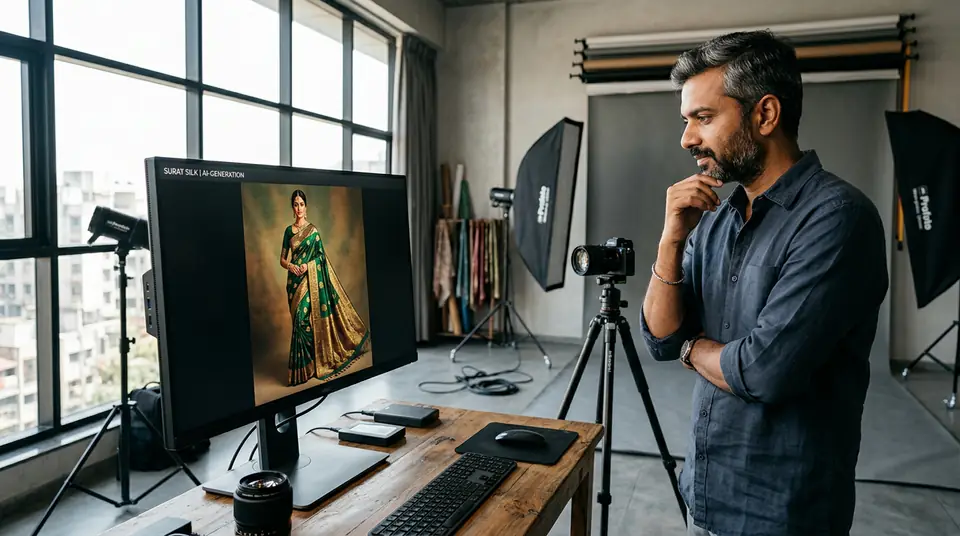
The Surat Studio's Sunday Problem
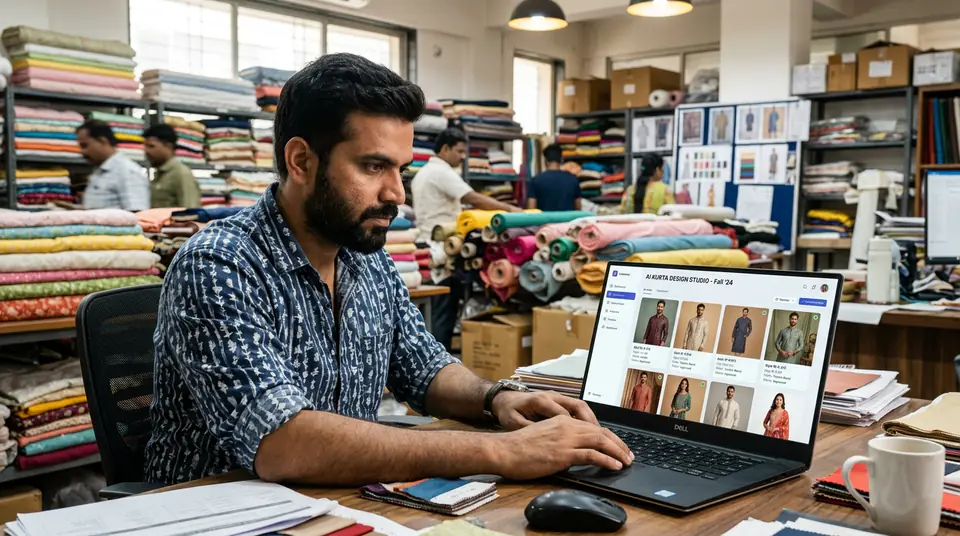
It’s 11 PM on a Sunday in a Surat photo studio. The smell of chai has gone stale, and the only light is from a monitor casting long shadows over a table littered with textile samples. For the studio owner, this is the most dreadful hour of the week. Not because the work is hard, but because it feels endless. Spreadsheets are open, detailing next week’s catalogue shoots: 40 sarees for one client, 60 kurtis for another, all needing five standard poses on a white background, all for a margin that feels thinner than tissue paper. This story follows a composite of studio owners I know in the textile hubs of India; it's an illustration of a pattern, not the story of one single business. The owner in our scenario has built a respectable business over ten years, but the pressure is immense. Clients want everything faster, cheaper, and yesterday. His Sundays are spent planning how to survive Mondays.
When the Math Stops Working
The breaking point arrives not as a loud crash, but as a quiet email. A legacy client, a textile house they’ve worked with for seven years, is putting their quarterly contract ‘on hold’. The reason? They’re ‘exploring in-house AI solutions’ to cut costs and speed up listings for marketplaces like Meesho and Myntra. It’s a gut punch. This wasn't a client lost to a competitor studio; it was a client lost to a piece of software. Suddenly, the thin margins don't just feel tight, they feel fragile. The entire business model, built on volume and efficiency, now seems like a house of cards in a digital hurricane.
₹25,000 - ₹40,000
Traditional Day Rate (Model, MUA, Studio)
7-10 Days
Turnaround for 50 SKUs
15-20%
Typical Net Profit Margin
High & Increasing
Risk of Client Churn to AI
The Race to the Bottom (And Why It’s a Trap)
The first instinct is to fight back. To compete. The studio owner tries offering a 20% discount to win the client back. He experiments with a ‘budget’ package, using a cheaper model or skipping the professional makeup artist. It’s a disaster. The quality drops, the images look flat, and the client isn't impressed. Worse, word gets around that the studio is offering discounts, and now every client wants a lower price. This is the death spiral of a service business trying to compete with a product on price. You cannot win. Your costs—rent, salaries, equipment—are real. The cost of a bit of code is almost zero. Competing on price is a race you are guaranteed to lose.
The core mistake is thinking clients want cheaper photos. What they actually want is a cheaper, faster way to get listings live and making money. Your photography is just one step in that process. If you only focus on making your step cheaper, you devalue your primary skill and still lose to the automation that streamlines the whole process.
How Photography Studios Can Use AI as a Multiplier, Not a Replacement
The real shift happens when the studio owner stops thinking about how to beat AI and starts thinking about how to use AI. He spends a week not shooting, but studying. He looks at dozens of tools. Many are flimsy, consumer-grade apps. But then he finds DrapifyApp. It’s built for Indian sellers. It understands sarees and kurtis. Crucially, it has a pay-as-you-go model with credits that never expire, so there's no big subscription to worry about. He uploads a single, high-quality photo of a kurti from a recent shoot. In three minutes, he has the same kurti on five different models in ten different poses. This is the moment.
He realizes the answer isn't to abandon the studio; it's to make the studio the source of unbeatable quality. His expertise in lighting, styling, and getting that one perfect shot is his moat. That hero shot becomes the high-quality input for the AI. The new workflow is simple: Shoot one of each style perfectly. One garment, one model, perfect lighting. Then, use DrapifyApp to generate the rest. All five colour variants. Three more poses for the A+ content on Amazon. A few lifestyle backgrounds for Instagram. His studio is no longer a factory for repetitive images. It’s a laboratory for creating the perfect 'seed' image that AI can then multiply. This is a far more strategic approach than just doing a basic AI model photoshoot.
Building the Hybrid Package: A New Way to Price Your Services
With this new workflow, the studio owner stops selling his time and starts selling outcomes. He creates a 'Hybrid AI' package. He walks back to his old clients, not with a discount, but with a new proposition. Instead of 50 images for ₹X, he now offers 200 images for ₹X + 20%. The package includes one hero studio shot per SKU, plus AI-generated colour variants, additional poses, and background options. It's more value for the client, delivered in half the time, and it’s more profitable for the studio. The conversation changes from cost-per-photo to value-per-listing.
| Feature | Traditional Studio | Hybrid AI Studio | Pure AI (Client DIY) |
|---|---|---|---|
| Base Image Quality | Professional | Professional | Variable (Depends on input) |
| Colour Variants | Requires Reshoot (High Cost) | Generated Instantly (Low Cost) | Generated Instantly |
| Poses Per Outfit | 2-3 (Time Consuming) | 5-10+ (Generated) | 5-10+ (Generated) |
| Turnaround Time | 7-10 Days | 2-3 Days | Minutes |
| Creative Control | Total | High (Studio directs hero shot) | Limited to AI capabilities |
| Typical Cost (20 SKUs, 5 variants) | ₹80,000+ | ₹55,000 | ~₹9,000 + time/effort |
Let’s model the cost for a client with 20 kurtis, each in 4 colours (80 final photos). Traditional way: Shoot all 80 variations. At least 2 full studio days. Cost to client: ~₹60,000. Studio profit: ~₹12,000. Hybrid way: Shoot only the 20 hero kurtis. 1 studio day. Cost for shoot: ₹30,000. Then, generate the 60 colour variants using DrapifyApp. At a bulk rate, let's say this costs the studio ₹600. The studio charges the client a service fee of ₹10,000 for the AI work. Total cost to client: ₹40,000. Total studio revenue: ₹40,000. Studio costs: ₹18,000 (studio day) + ₹600 (AI) = ₹18,600. Studio profit: ₹21,400. The client saves ₹20,000, and the studio almost doubles its profit. The ability to generate color variant photos with AI models is the key.
Who This New Model Is NOT For
This hybrid approach isn’t a magic bullet for every photography business.