01.Why Your Photo Background is Secretly a Sales Funnel
Let's get one thing straight. Your product photo background is not empty space. It’s the first filter in your sales funnel. It's the signal that tells a customer whether your ₹2,500 kurti is a premium boutique piece or just another listing lost in the chaos of Meesho. Get the background wrong, and the right customer scrolls right past you. That's why having the right background ideas for clothing product photos isn't about being artistic; it's about being strategic. A single garment needs to show up perfectly on a sterile Myntra search page and in a vibrant, story-driven Instagram feed. Two different worlds, two different rules.
The core problem is this: marketplaces demand uniformity, but your brand needs personality to stand out. How do you serve both masters without running two entirely separate, expensive photoshoots? You build a system. Here are the seven essential background types you need to know, ordered from the looks that build high-end brands to the ones that simply get you listed.
02.1. The Hard Shadow Industrial Look
The hard shadow industrial look uses a single, direct light source to cast a sharp, defined shadow against a plain concrete, plaster, or coloured wall. It’s an edgy, high-fashion aesthetic that screams 'designer' and deliberately breaks the old rule of 'soft, even lighting'. This approach is perfect for streetwear, denim, gender-neutral clothing, or any minimalist brand targeting a younger, urban audience on their own D2C website or Instagram. It conveys confidence and makes the product feel graphic and bold, instantly separating it from softer, more generic e-commerce photography.
03.2. The Contextual Lifestyle Scene
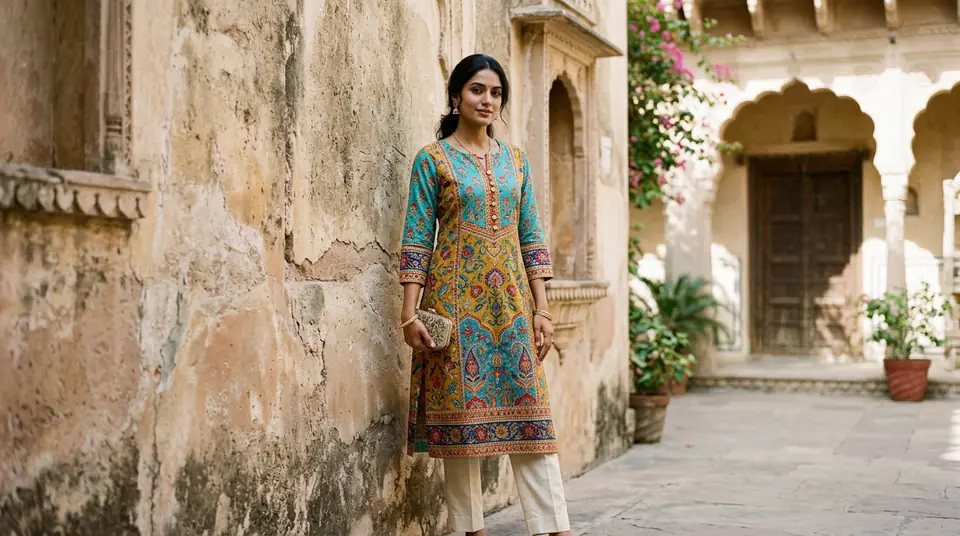
A contextual lifestyle background shows your product in a believable, aspirational setting—think a Jaipur haveli courtyard for ethnic wear, a breezy Goa cafe for resort wear, or a sharp Mumbai office lobby for formal shirts. This background tells a story, helping the customer visualize the garment in their own life, which is why it's the highest-converting style for social media, ads, and brand websites. The problem? It's a nightmare to keep consistent and affordable. A one-day location shoot can cost upwards of ₹50,000 and the lighting will never be the same twice.
This is precisely the problem AI solves. Tools like Drapify Studio let you create entire campaigns in consistent, premium lifestyle locations from a single flat shot of your garment. You get the aspirational look without the logistical chaos.
04.3. The Textured Wall (Linen, Plaster, Brick)
A textured background, like a raw plaster wall, an exposed brick surface, or even a large hanging sheet of linen, adds depth and a premium, tactile feel without distracting from the clothing. This approach is a fantastic middle-ground between a sterile flat color and a busy lifestyle scene. It signals that your product is artisanal, hand-crafted, or from a thoughtful boutique. It’s a subtle upgrade that makes a huge difference in perceived value, especially for categories like handloom sarees, block-printed kurtis, or organic cotton basics.
05.4. The Solid Colour Block
Using a single, bold, on-brand solid colour as a background is the fastest way to make your products pop and create a memorable, scroll-stopping brand identity on Instagram. Many top D2C brands use this to 'own' a specific colour in their customers' minds. It’s powerful, it’s confident, and it makes your feed look like a professional, curated collection rather than a random assortment of clothes. The key is to choose a colour that complements your entire product range, not just one or two items.
Don't guess which color works. You can use an AI model photoshoot tool to upload your product and test it against dozens of background colours in seconds. This lets you see if that trendy lavender background washes out your pastel kurtis before you commit to buying a full roll of paper backdrop.
06.5. The Light Grey (The 'Smarter' White)
A light grey background (think hex codes #F0F0F0 to #E0E0E0) is the most versatile backdrop in e-commerce, frequently accepted by marketplaces while looking far more sophisticated than stark white on your own website. It provides a softer contrast, which can make the colours on your garments appear richer and is less straining on shoppers' eyes. For many brands, this is the perfect 'one background' solution if they want to maintain a single set of images across all channels, though pure white is still the safest bet for Amazon's primary image slot.
07.6. The Pure White (#FFFFFF)
This isn't a creative choice; it's a mandatory requirement for the primary image on major Indian marketplaces like Amazon and Myntra. A pure white background (#FFFFFF) ensures a clean, consistent shopping experience on the platform and is critical for your products to even show up in filtered searches. There is no room for negotiation here. Your main hero image must have it. While other secondary images can have different backgrounds, the first one the customer sees is almost always required to be on pure white.
| Marketplace | Primary Image Background | Resolution (pixels) | File Size Limit |
|---|---|---|---|
| Amazon India | Pure White (#FFFFFF) | Min 1000px on longest side | <10MB |
| Myntra | Pure White or Light Grey | 1080 x 1440 | <1MB |
| Flipkart | White or Light Grey | Min 1100px on longest side | <5MB |
| Meesho | Any clean, non-distracting background (White recommended) | Min 500x500 | <10MB |
Getting this perfect white background is harder than it looks and is a common reason for catalogue rejection. Shadows, off-white walls, or poor editing will get your listings flagged. This is why thousands of sellers use DrapifyApp to generate compliant Myntra catalogue photos instantly. Upload one photo of your garment, and get a perfect shot on a model against a pure white background, guaranteed to pass QC.
08.7. Background Ideas for Clothing Product Photos as Flat Lays
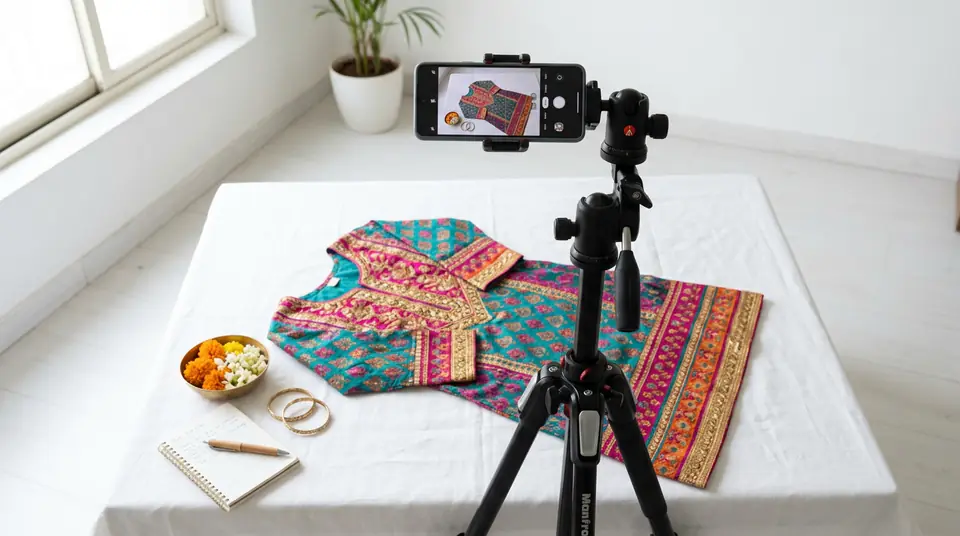
For flat lay photos shot from directly above, the best backgrounds are textured surfaces that add context and character, such as a weathered wooden table, a cool marble slab, or a clean concrete floor. This 'top-down' style is excellent for showcasing product details, creating outfit grids with accessories, and for populating your Instagram feed with varied content. It gives a behind-the-scenes, editorial feel that customers on social media love to engage with.
But be warned: flat lays are terrible as primary marketplace images. Customers can't judge fit or drape, so conversion rates are low. They work best as a secondary image. To get more value from your efforts, you can use AI to turn flat lay photos into on-model photos, giving you a marketplace-ready hero image and a social media shot from the same original picture.
09.Who Can Ignore This Advice?
If you're a fabric wholesaler selling by the metre to other businesses on WhatsApp, a clean floor and good lighting is probably enough. If you sell one-of-a-kind vintage pieces to a small, loyal following on Instagram, your unique brand voice matters more than a consistent background. But for anyone trying to scale an online fashion brand on marketplaces or a D2C store, your background is a non-negotiable part of your selling machine. Treat it like one.
10.The Hidden Cost: Your 'Background Inconsistency' Tax
The real cost of bad backgrounds isn't the ₹500 for a paper roll. It's the thousands in lost sales and reshoot costs from a messy, inconsistent catalogue that erodes customer trust. Let's calculate the real 'inconsistency tax' for a small brand with a 50-product catalogue.
| Cost Item | Assumption | Estimated Cost |
|---|---|---|
| Studio Shoot (Batch 1) | 1 day for 25 products @ ₹20,000 | ₹20,000 |
| Outdoor Shoot (Batch 2) | 1 day for other 25 products, different light/look | ₹25,000 |
| QC Rejections & Retouching | 10% of products fail Myntra QC due to inconsistent backgrounds | ₹5,000 |
| Lost Sales (Conversion Drop) | Messy catalogue lowers conversion by 0.5% on ₹5 Lakh/mo revenue | ₹2,500/month |
| Total First-Year Cost | One-Time Costs + (Lost Sales x 12) | ₹80,000 |
Just by having two different-looking shoots, you've spent ₹50,000 and stand to lose another ₹30,000 in sales over a year. That's an ₹80,000 tax on inconsistency. A scalable, consistent system for your backgrounds isn't a 'nice-to-have'; it's fundamental to your profitability.