The Invisible Wall at ₹10 Lakh
Most entrepreneurs in Surat, Delhi, or Kolkata who come to me think it’s a marketing problem, or inventory management, or even supplier issues. They're wrong. More often than not, for saree brands, the bottleneck is far simpler, yet far more stubborn: your catalogue photography. We hit this invisible wall in our own family business, back when we were trying to move beyond just local wholesale.
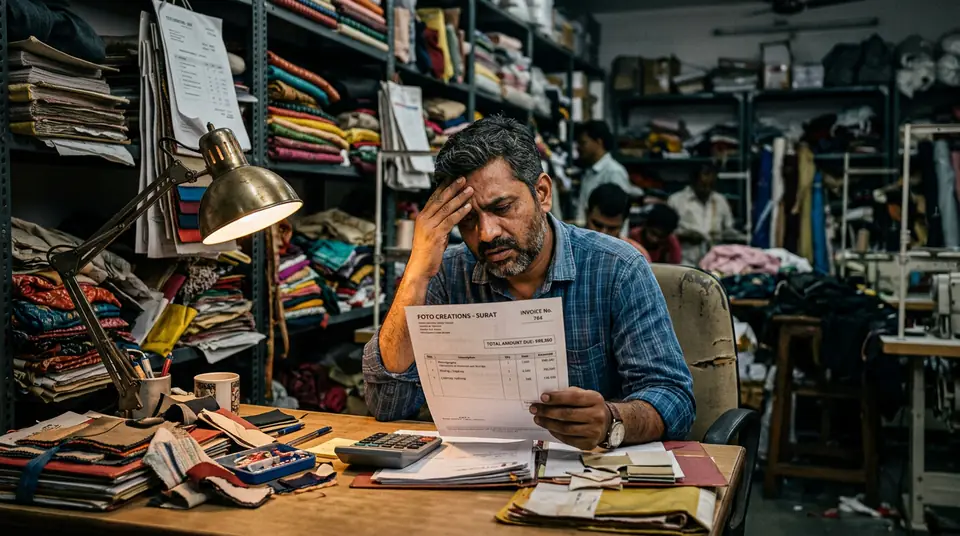
The thing is, the process of getting a saree from the loom to a clickable listing is deceptively complex. For 50 SKUs, it’s manageable. You shoot a handful of designs, get them retouched, upload to Myntra or your Shopify store. Repeat. But try doing that for 500 new designs, each with three colour variants, every season. Or worse, 200 new silk sarees for Eid next month, and you’re still waiting on retouched photos from last quarter’s collection. That’s the point where most brands, good brands, with great products, simply can't scale beyond that ₹10 lakh ceiling. The system of getting your saree catalogue photography done just isn’t built for volume.
The compromises start piling up. You settle for fewer angles, less consistent lighting, maybe even reuse old model shots. You tell yourself, "It's just a listing photo, customers mostly care about the fabric." And that, my friends, is the beginning of the end for your saree brand scaling ambitions. Your saree ecommerce conversion rates start to slide, and you're left scratching your head.
The Studio Cost Trap & The 'Good Enough' Delusion
“I heard a client just last week, a wholesaler from Ahmedabad, tell me, 'Look, my fabric quality is top-notch. My designs are unique. Why should I spend another ₹500 on a photo when I sell it for ₹1200? The listing photo is just 'good enough'.'”
That's the mindset that keeps businesses small. Let's be brutally honest about studio costs in India. A decent fashion photoshoot in Mumbai or Bangalore, with a professional photographer, a couple of models, a stylist, makeup artist, and studio rental? You're looking at ₹30,000 to ₹60,000 for a single day. And what do you actually get from that? If you're efficient, maybe 30-50 final, retouched, usable images for your catalogue. Think about it. That's ₹600 to ₹2,000 per photo. And then there are the hidden costs: your travel, the time spent coordinating, the endless rounds of feedback and retouching.
Many of us (and I include my younger self here) fall into the "good enough" trap. We think if the saree is beautiful, a basic photo will suffice. But 'basic' doesn't stand out on Myntra or Ajio. 'Basic' doesn't inspire confidence. 'Basic' leads to higher return rates because the customer received something that didn't quite match the 'good enough' photo. This isn't just about saving money on a shoot; it's about the lost sales, the wasted ad spend, and the eroding brand perception from inconsistent ethnic fashion photography.
And if you’re thinking, “But my existing photographer is family!” I hear you. We faced that too. It’s hard to change established ways, especially when relationships are involved. But you have to ask yourself: is loyalty costing you scale?
Generate your own AI fashion photoshoot with Drapify — 50 free credits, no card required.
Breaking the Bottleneck: Consistency at Speed
The game changed for us when we realized we didn't need to replace the idea of photography, but the process. We needed saree catalogue photography that didn't eat into our profits or our tight launch schedules. This is where we started experimenting with AI for product photos. Skeptical? So was I. We'd been burned by other tech solutions before (don’t even get me started on that ill-fated inventory software from 2018).
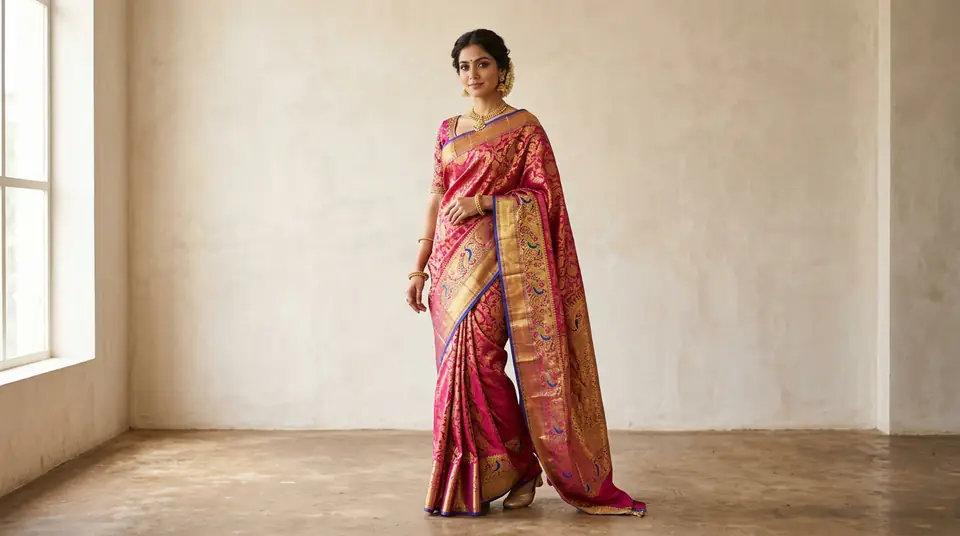
But the results with platforms like DrapifyApp were undeniable. What used to take days, sometimes weeks, from shooting to final upload, suddenly took minutes. We could get a high-quality product photo from a single garment shot in about three minutes, for roughly ₹13-15 per photo. Think about that math compared to the ₹800+ from a studio. It’s a no-brainer for volume.
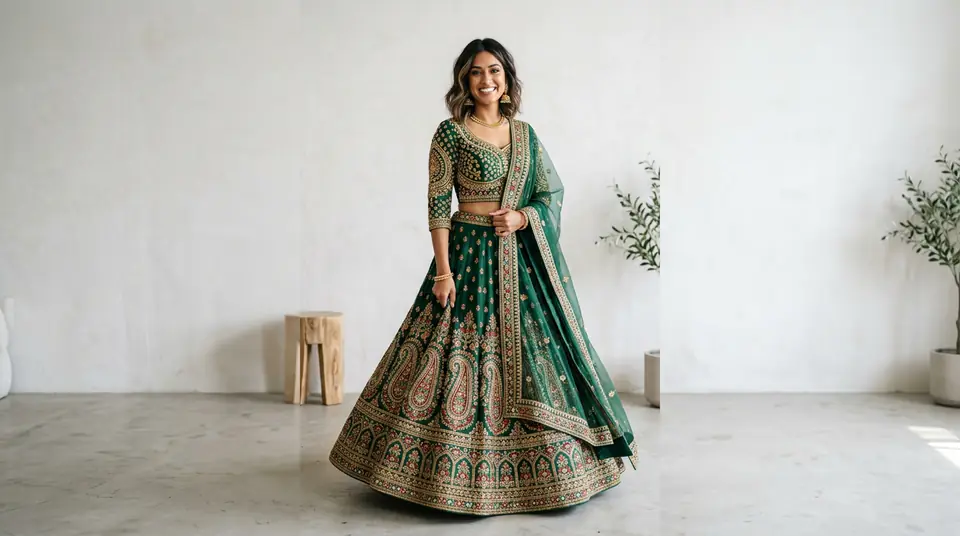
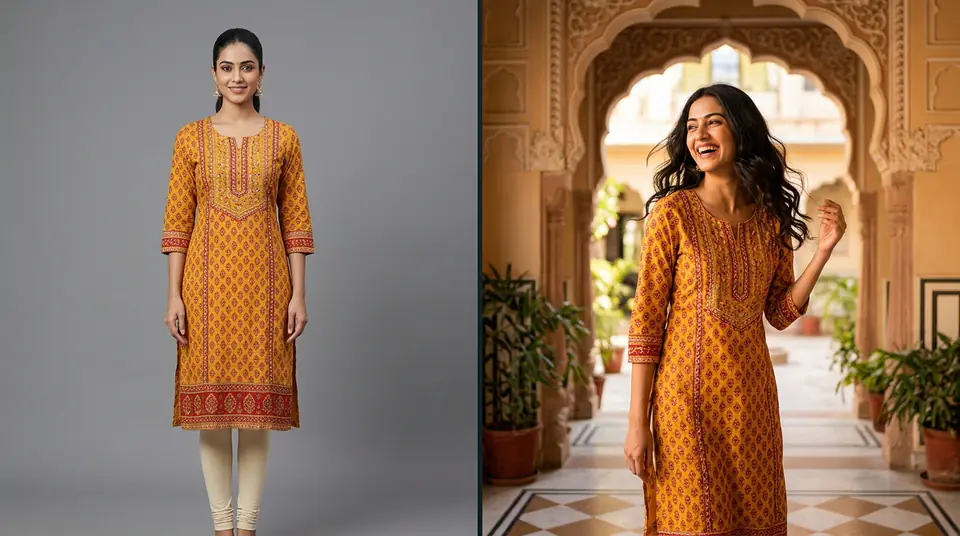
The real breakthrough wasn’t just the cost, it was the consistency. We could generate dozens of poses for the same saree, with identity-locked models, ensuring our brand look was uniform across hundreds of new designs. This meant we could finally offer all colour variants of a saree with its own unique model shot, without needing another studio day. That’s a huge win for online saree selling.
Beyond Listings: The Full Funnel Photo Strategy
Good photos aren't just for product pages anymore. This is where AI really shines for saree ecommerce. Before, we’d painstakingly select 3-4 images for our Myntra listing and then hope they’d also work for Instagram ads. Now, we generate five different angles for the listing, ten different creative variants for social media ads, and another five for our WhatsApp catalogue – all from the same original garment photo.
Have you ever seen your ecommerce CTR CVR numbers and scratched your head? High click-through but low conversions? Often, it's a photo-match problem. The ad creative hooks them, but the product page photo doesn't quite deliver the same vibe or quality. With AI fashion photography, you can test endless ad creatives that perfectly match your high-quality, consistent product page photos. It closes the loop. This means better performance on Amazon India, Flipkart, Myntra, and even your direct-to-consumer website.
Imagine launching a new collection of 100 designs. You need 5 shots per design for listings (500 photos). You also need 3 unique ad creatives per design (300 photos). Total 800 photos. Doing that with traditional methods? Months and lakhs. With DrapifyApp? A few days and a few thousand rupees. That kind of speed and cost efficiency is what finally allowed our saree brand scaling to break past that ₹10 lakh ceiling and reach much higher.
It's Not About Replacing, It's About Empowering
Now, don’t misunderstand me. I’m not saying ditch human photographers entirely. For a high-concept brand campaign, an editorial shoot with a specific artistic vision, you absolutely need a talented human behind the lens. But for the sheer volume of catalogue work, for generating hundreds upon hundreds of consistent product images for your saree catalogue photography – that’s where AI is not just a tool, but a necessity.
It frees up resources. The money saved on repetitive shoots can be reinvested into better fabric sourcing, design innovation, or even strategic marketing. The time saved means faster time-to-market for new collections, which is gold during festival seasons like Diwali. The future of ethnic fashion photography isn't either/or. It's hybrid. It’s smart. It’s about leveraging technology to empower your business to do more, faster, and more affordably.
The ₹10 lakh ceiling isn't a hard limit; it's a sign that your current photography workflow isn't built for scale. Change that, and watch your saree business grow.