The Real Cost of Traditional Model Photoshoots in India
A traditional model photoshoot for a fashion brand in India isn't just the model's fee; it's a complex web of interconnected expenses that can quickly escalate, often surprising even seasoned sellers. Many believe a single day's shoot for 50-100 products costs ₹25,000-₹50,000. It's usually much more.
| Item | Typical Cost (₹) | Notes |
|---|---|---|
| Model Fees (1-2 days) | 15,000 - 40,000 | Per model, per day (8-10 hours). Varies by experience and agency. Booking two models is common for variety. |
| Photographer Fees (1-2 days) | 20,000 - 50,000 | Includes equipment, setup, and expertise. More for established names or specific niches like jewellery. |
| Studio Rental (1-2 days) | 10,000 - 30,000 | Daily rate for a decent setup in Mumbai or Delhi. Includes lights, backdrops. |
| Stylist / Makeup Artist | 8,000 - 20,000 | Essential for professional looks. Daily charges. |
| Photo Editor / Retouching | 5,000 - 15,000 | Per shoot or per image. Often outsourced post-shoot. Crucial for marketplace compliance. |
| Logistics / Travel | 2,000 - 10,000 | Transporting garments, props, and crew. Snacks, water, contingency. |
| Garment Handling / Ironing | 1,000 - 3,000 | Preparing garments for each shot. |
| Outfit Changes & Setup | Time Cost | Each change eats 5-10 minutes. A 100-product shoot means 100 outfit changes, plus styling. |
| Reshoots (if needed) | Full Cost of the Day | If lighting, styling, or model expressions are off. A complete disaster. Can be 50%-100% of original cost. |
Adding it all up, a two-day traditional shoot for 100 products (assuming 50 products per day) with a single model in a city like Bengaluru or Delhi can easily hit ₹70,000-₹1.2 lakh. This doesn't even account for the opportunity cost of your time managing the shoot, coordinating everyone, and the stress of deadlines. For a Surat saree wholesaler aiming to refresh 300 new designs every quarter, these costs become astronomical. You can dive deeper into the specific numbers for various garment types in our guide to saree photoshoot cost in India.
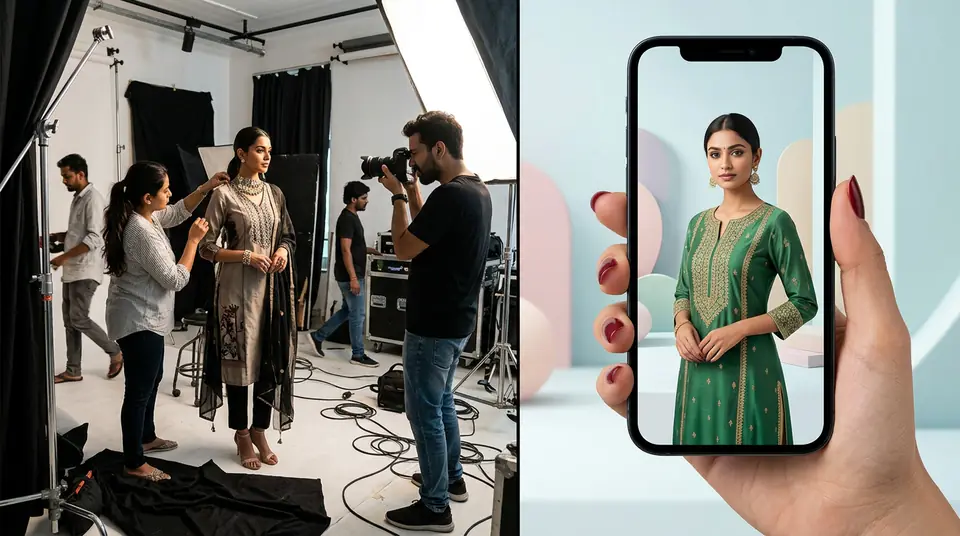
Understanding the AI Model Alternative: A New Equation
AI models fundamentally change the cost structure by removing the variable costs associated with physical presence and time. Instead of paying for people, space, and hours, you pay per image generated, typically a fraction of the traditional cost.
| Item | Typical Cost (₹) | Notes |
|---|---|---|
| AI Model Image Generation | 9 - 35 per image | With DrapifyApp, costs range from ₹9 (for 1K resolution) to ₹35 (for 4K resolution). First HD photo free at /home. |
| Source Photo (flat-lay/ghost mannequin) | 0 - 200 | You already have these. If not, a simple flat-lay can be shot on a phone for minimal cost. |
| Variations (poses, backgrounds, models) | Included in image cost | No extra charges for different poses, diverse models, or new backgrounds. |
| Reshoots / Re-generations | Cost of new image (auto-refunded if failed) | If an image isn't perfect, you regenerate it. DrapifyApp refunds credits for failed generations. |
| Time Cost (your end) | Minutes per image | Upload a flat-lay, select model/pose/background, generate. ~3 minutes per photo. Far less coordination. |
| Overhead Costs (studio, MUA, stylist) | 0 | Completely eliminated. No physical setup needed. |
| Usage Rights | Included | Full commercial usage rights are inherent in the generated images. |
The math here is stark. For a 100-product catalogue, using DrapifyApp could cost you ₹900-₹3,500 for high-quality, on-model images, depending on resolution. This is a 95%+ reduction compared to traditional methods. If you're running an Amazon India fashion store or selling kurtis on Myntra, this efficiency is critical for margin. You can even generate multiple color variant photos with AI models without reshooting the actual garment.
AI Models vs Real Models for Fashion Brands: The Head-to-Head Comparison
When comparing AI models vs real models for fashion brands, the decision isn't just about the invoice total; it involves speed, flexibility, and creative control. Below is a concise comparison to help you run your own numbers.
| Factor | Real Models | AI Models (e.g., DrapifyApp) |
|---|---|---|
| Typical Cost (per 100 images) | ₹70,000 - ₹1,20,000+ | ₹900 - ₹3,500 |
| Turnaround Time | Days to weeks | Minutes to hours |
| Flexibility (poses, expressions, backgrounds) | Limited by model availability, studio setup, budget for reshoots | Unlimited variations. Change model identity, pose, background, even garment colors instantly. Identity-locked models across poses. |
| Logistics & Coordination | High: scheduling, transport, managing crew | Minimal: upload garment image, select options. |
| Scalability | Difficult & expensive to scale quickly for large catalogues or frequent refreshes. | Highly scalable. Generate thousands of images per day. Ideal for bulk catalogue photography. |
| Usage Rights | Often time-bound or region-specific. May require renewals. | Full commercial rights included, forever. |
| Consistency | Hard to maintain across multiple shoots/seasons. | Perfect consistency for model identity across diverse poses and garments (Drapify Studio). |
| Diversity | Requires casting and booking diverse models, adding cost/complexity. | Access to a wide range of diverse Indian models instantly. |
| Reshoots / Corrections | Costly, time-consuming, requires re-booking. | Instant regeneration, often with auto-refund for failed attempts. |
This isn't to say AI models are perfect for every situation, but for the vast majority of ecommerce fashion sellers in India, especially those on platforms like Myntra or Meesho, the economic and practical advantages are overwhelming. You can test out DrapifyApp right away for free to see for yourself how AI models can transform your ecommerce product photography.
When Traditional Photoshoots Still Hold Their Ground
Despite the clear advantages of AI models in terms of cost and speed, traditional photoshoots still make sense for very specific brand objectives. You don't abandon the old ways just because new tech arrives; you apply each tool where it makes the most sense.
For the typical Indian fashion seller, operating on marketplaces or a D2C store, the balance has undeniably shifted. The math stops working for traditional methods when you consider the sheer volume of images needed, the constant refreshing of catalogues, and the tight margins.