Why do my boutique photoshoots eat up all my weekend time?
Your boutique photoshoots eat up all your weekend time because, like me, you're likely wearing too many hats, trying to manage every single detail from model selection to lighting, and it's simply not a scalable process for a small business owner.
I used to know this feeling all too well. Each Saturday or Sunday, my little boutique in Jaipur would transform into a chaotic studio. First, there’s the hunt for a good location, or maybe it’s just rearranging furniture in my living room for the nth time. Then comes the model – finding someone reliable, paying them, dealing with no-shows. Outfit changes? A nightmare. The constant retakes for that 'perfect' drape. You know, the one where the dupatta isn't folded weirdly. And then, the actual photography itself: playing around with angles, light, trying to make my iPhone look like a professional DSLR. The whole thing was exhausting. More than exhausting, actually; it was stealing precious family time.
It’s not just the shooting, either. Post-production is a beast. Culling through hundreds of images, basic edits, sending them to a retoucher if your budget allowed for it. It was a never-ending cycle, especially when new stock arrived every couple of weeks. My business was growing, which was wonderful, but my personal life was shrinking. Something had to give.
How much does a typical small fashion photoshoot really cost in India?
For a traditional setup, even a 'small' photoshoot for a boutique in India can easily set you back anywhere from ₹25,000 to ₹50,000 for a single day, not including the immense value of your lost personal time.
Let’s break it down, based on my own past experiences and what I hear from other boutique owners in Rajasthan. You start with the model. A decent freelance model for a day might cost you ₹5,000 to ₹15,000. Then there's the makeup artist – another ₹3,000 to ₹8,000. If you’re renting a studio, that's another ₹7,000 to ₹15,000. Or, if you’re using your living room, think about the effort to clear it, set it up, and then put it all back.
A professional photographer, even a budding one, will charge ₹10,000 to ₹25,000 for a day, plus editing. Add in travel, food for the team, and unexpected expenses. It all adds up fast. My first few big shoots for Myntra listings felt like I was burning cash just to get the products listed. It put a huge dent in my margins. And honestly, for a boutique with maybe 30-50 SKUs per collection, that kind of investment for a handful of images just doesn't make sense if there are better ways.
₹5,000-₹15,000
Cost for a freelance model per day
₹3,000-₹8,000
Cost for a makeup artist per day
₹10,000-₹25,000
Cost for a photographer per day
₹25,000-₹50,000
Total cost for a small boutique photoshoot
Can I get professional-looking photos for my boutique without hiring a team?
Yes, absolutely, many boutique owners are now leveraging smart tools and AI technology to produce high-quality catalogue images right from their phone, skipping the whole team and studio drama.
When I first started, I tried everything. I watched YouTube tutorials on flat lay photography. I bought a ring light. I even attempted to be my own model for some clothes, which, let me tell you, was both hilarious and incredibly inefficient. The results were… okay. Good enough for WhatsApp maybe, but not the crisp, consistent look I wanted for Ajio or Amazon India. The colours would be off, the lighting inconsistent, and models? Forget it. Getting diverse models with professional poses felt impossible without a proper budget.
This is where AI platforms like DrapifyApp have changed the game for small businesses like mine. You don't need a professional camera, a studio, or even a model. You just need your product. I'm talking about taking a simple, clear photo of your garment – on a hanger, on a mannequin, or even laid flat – with your smartphone. That one photo is all the AI needs to create an entire photoshoot for you. It's truly liberating, and it means boutique photography doesn't have to be a major production.
Even with your phone, make sure your initial garment photo is well-lit, in focus, and against a clean, plain background. This gives the AI the best starting point for a stunning final image. Good input, good output. Always.
Generate your own AI fashion photoshoot with Drapify — 50 free credits, no card required.
Do AI fashion photos actually look real enough for my brand's catalogue?
Modern AI fashion photography is incredibly realistic, so much so that many customers won't distinguish them from traditional studio shots, especially when generated at 2K or 4K resolution.
I was skeptical, too, when I first heard about DrapifyApp. My biggest concern was, 'Will these look like robots wearing my kurtis?' But their 2K and 4K output options mean the photos look crisp even when zoomed in on Myntra or Amazon, truly matching the boutique catalogue quality I aspire to. The details on fabrics like Banarasi silk or intricate embroidery on a lehenga are surprisingly sharp. It's not like the old days of clunky CGI; this is sophisticated stuff.
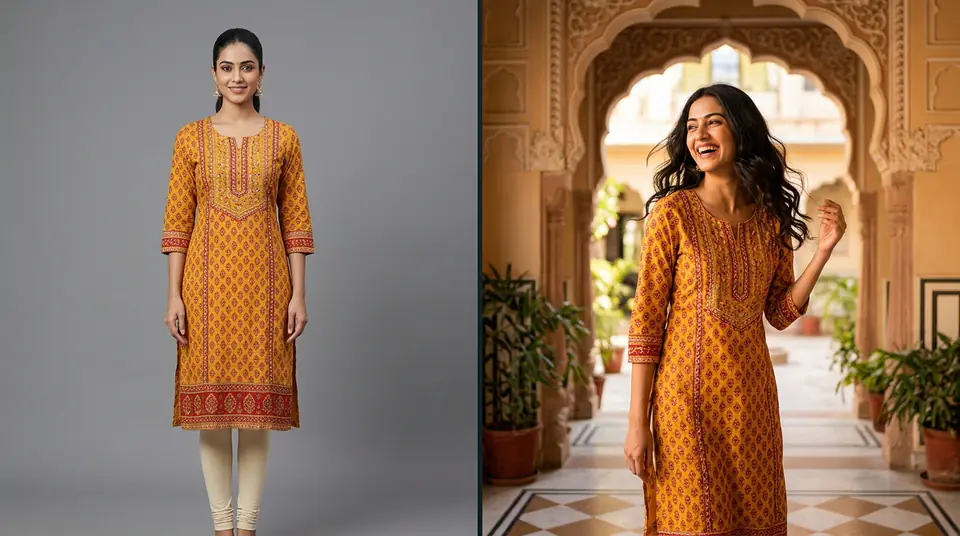
You upload just one clear picture of your kurti or lehenga, and DrapifyApp generates a full catalogue of images on diverse models in different poses, often in under 3 minutes. And the models? They're identity-locked, so your customer sees the 'same' face across all your variants and poses, building that consistent brand feel. I've used it for sarees, menswear, and even some intricate jewellery shots. The results are always convincing and professional. Plus, if a shot isn't perfect, they auto-refund the credits. No harm in trying those 50 free credits they give you.
For my Diwali collection, I had six new designs of Anarkali suits. Instead of a full-day shoot, I took flatlay photos of each. Within an hour, I had 48 unique, professional model shots ready for my WhatsApp catalogue and Facebook ads. The conversion rate was fantastic, largely because the photos looked so cohesive and appealing.
How do I make sure all my product photos have a consistent look?
Achieving consistency across your catalogue boils down to standardizing your lighting, backgrounds, and model presentation, which is precisely where AI tools shine and make your boutique photography stand out.
Consistency is crucial for building a strong brand identity. When a customer lands on your Instagram feed or a Myntra listing, they shouldn't see twelve different brands because your product photos all have different vibes. It signals professionalism and trustworthiness. But for a small business doing DIY, it’s a huge challenge. One day, the sun is bright; the next, it's cloudy. You might use different spots in your house. Maybe a friend modeled for one collection, and your cousin for another. The result is a messy, disjointed visual.
AI photography platforms eliminate these variables. Once you select a background and model style, the AI replicates it across all your products. Every image has the same digital 'studio' setup, the same consistent lighting, and if you choose, the same identity-locked model. This uniformity makes your entire collection look polished and professional, like you invested in a huge studio shoot, but you didn't. This also means you can maintain a unified aesthetic even if you're launching colour variants. Before DrapifyApp, my catalogue looked like a mishmash. Now, whether it's a new saree or a colour variant of an old top, the look is unified. Plus, they handle colour variants without needing a reshoot, saving a tonne of effort and cost.
What's the fastest way to get new stock online without compromising photo quality?
The fastest way to get your new stock online with high-quality photos is to integrate AI photography into your workflow, allowing you to generate catalogue-ready images as soon as products arrive, streamlining your boutique catalogue process.
Think about the traditional workflow: New stock arrives. You meticulously check each piece. Then, you wait for your next photoshoot date, which might be weeks away. After the shoot, there’s another waiting period for editing and delivery. By the time your products are finally listed, you’ve already lost valuable selling time, especially during peak seasons like Diwali or wedding season.
With AI-powered platforms, that entire timeline collapses. As soon as a new batch of block print kurtis arrives from Sanganer or a collection of elegant lehengas from Delhi, you can prepare them. Instead of waiting weeks for a photoshoot, you just need to take a clear flatlay photo of each garment. Upload it to DrapifyApp, choose your model and setting, and within minutes – yes, minutes – you have high-quality, professional catalogue images ready for your WhatsApp groups, Meesho, or your own Shopify store.
This means you can be the first to market with new designs, respond to trends faster, and keep your online storefront fresh and exciting without breaking the bank. For around ₹13-15 per photo, this isn’t just about saving time; it’s about making your small business agile and incredibly efficient. My Sundays are mine again, and my sales haven't dipped; they've grown.