The Invisible Inventory Costing You Lakhs
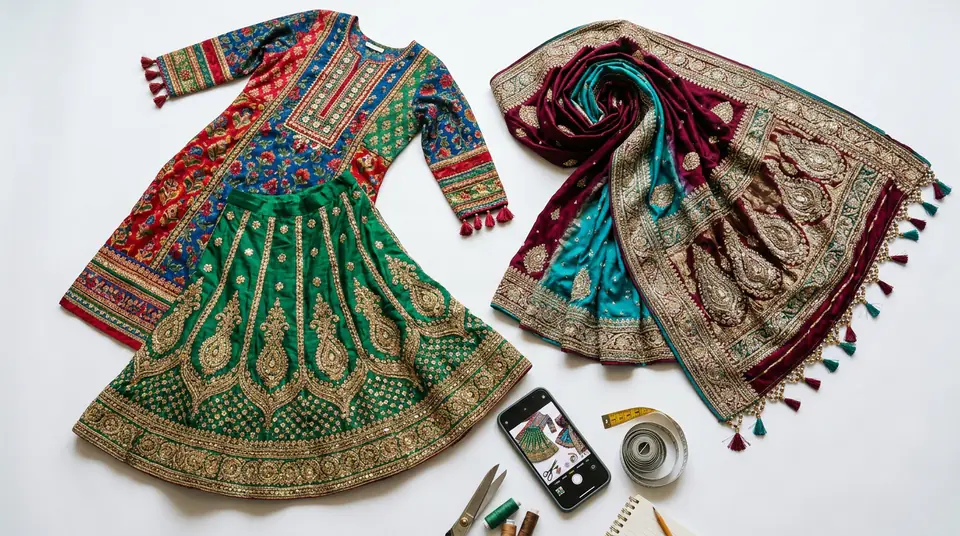
It’s a classic mistake, one I’ve made, one my competitors still make, and one that absolutely drives me up the wall. We spend months perfecting a design, sourcing the best georgette from Varanasi or processing the finest cotton in Surat, bringing it to life in a vibrant palette of five, eight, sometimes even twelve distinct colours. Each shade is carefully chosen, reflecting a trend or a festive mood. Then, when it comes time to put it online, for a Myntra, an Ajio, or even our own D2C storefront, what happens? We shoot two, maybe three colours. If we’re feeling ambitious, four. The rest? “See description for other colours.” Or, worse, just a tiny swatch that barely captures the hue. It’s infuriating, because I know, deep in my bones, that every single unseen product variant listing is a missed sale. And it’s not just a few rupees; it’s lakhs, disappearing into thin air.
Think about it from your customer's perspective. She’s looking for a specific shade of blue for an upcoming wedding, or a bright red kurti for Diwali. She lands on your listing, loves the design, but only sees it in teal and grey. The description says 'also available in royal blue'. Is she going to buy it? Maybe. Will she feel confident buying it? Probably not. The friction of imagination is a real, measurable cost in e-commerce. It introduces doubt, slows down the purchase decision, and often, leads to her clicking away to a competitor who shows all their cards.
Why 'Just Imagine It' Doesn't Work Online
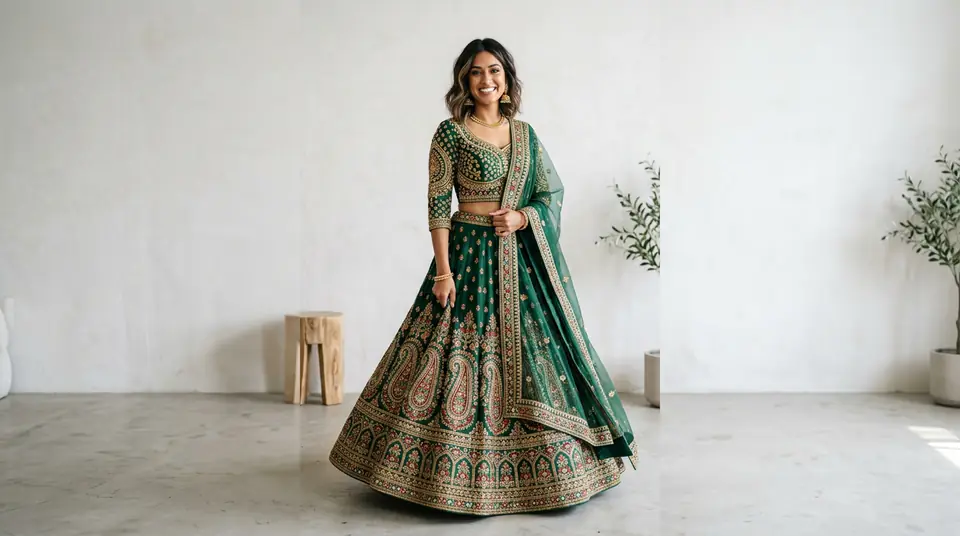
Our grandfathers in the textile business could lay out five fabric swatches on a counter in Gandhi Baug and ask a buyer to imagine a full ghagra choli. That worked then. It doesn't work now. Online, the visual is paramount. Our customers aren't just buying a garment; they're buying an experience, a feeling. And a tiny colour swatch doesn't convey that. They need to see how the fabric drapes in that specific colour, how light plays on its surface, how it looks on a model, how it feels to wear.
When you only show a couple of variants, you’re asking your customer to make a leap of faith. And in the brutally competitive Indian fashion e-commerce space, faith is a commodity in short supply. You're not just losing sales on the hidden variants; you're degrading the entire customer experience for that product. It also sets you up for higher return rates. Someone buys the 'crimson' variant based on a mental image, only to find it's more 'maroon' in person. Bang. Return initiated. Money lost, goodwill eroded. I had a client, a boutique owner from Ahmedabad, call me last month, utterly frustrated.
““Vishal, I don't get it. My indigo block print suits fly off the shelf, but the same design in sage green just sits there. Customers ask if the green is 'too dull' or 'too bright'. How do I even answer that? They just want to see it! It's the same fabric, same fit, but the green just doesn't move.””
Generate your own AI fashion photoshoot with Drapify — 50 free credits, no card required.
The Myth of the 'Expensive Photoshoot'
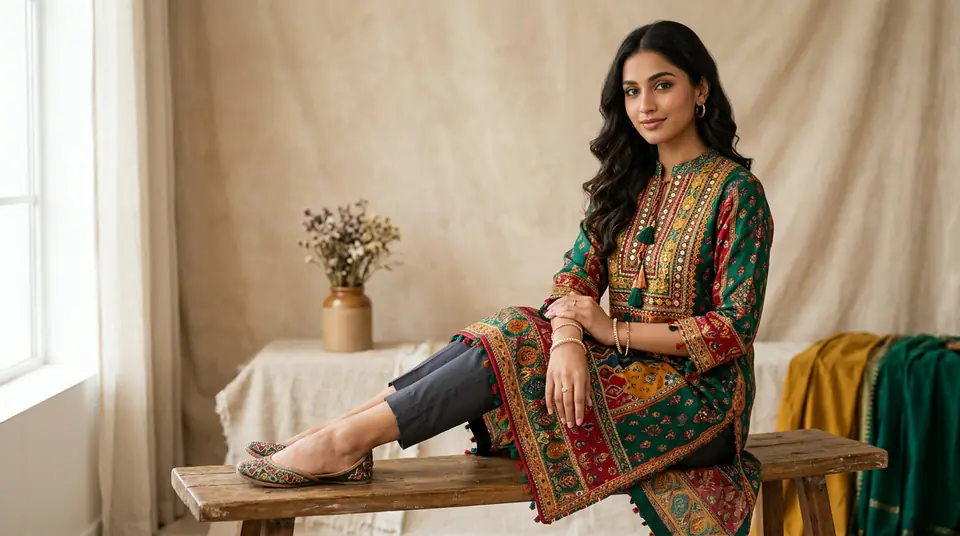
I get it, really. The knee-jerk reaction is always, 'But Vishal, color variant photography for every single shade? That's a studio day for each, an extra model booking, more makeup artists, more edits! It’ll cost me a fortune!' I’ve said it myself. A typical full-day studio shoot in Mumbai or Delhi, with models, stylists, photographers, and editing, can easily run you ₹60,000 to ₹1,00,000. If you have eight colours, that's potentially eight different shoot days or at least a massive, chaotic single day. The numbers add up fast, making it seem prohibitive for many small and medium-sized brands, especially with `multi colour sku` ranges.
But here's the thing: that upfront cost calculation completely ignores the lost revenue from your existing inventory. Let's say that kurti in eight colours has a margin of ₹500 per piece. If you’re selling 50 pieces of the visible colours but only 5 of the invisible ones, and you could be selling 30 of each if they were all properly photographed – that’s a direct loss of (25 pieces ₹500 5 variants) ₹62,500 per product line every month. Over a year, that’s ₹7.5 lakhs from just one design. Suddenly, that 'expensive' photoshoot doesn’t seem so bad, does it? The `catalogue photography cost` isn't just about what you pay, but what you don't earn.
A Surat Story: My ₹35 Lakh Lesson
Back in 2018, when we were still finding our footing in online retail, we launched a collection of rayon kurtis. Simple, elegant, perfect for everyday wear. We had six staple colours: black, white, navy, maroon, bottle green, and a lovely mustard. For the launch on Amazon India and Flipkart, we only shot the black, navy, and mustard. “Good enough,” I thought. “People know what maroon looks like.” (Oh, the hubris of youth!).
The black and navy sold well. Mustard was okay. Maroon and bottle green? They were dead stock. For months. Our `inventory management` reports showed alarming discrepancies. The stock was sitting there, taking up valuable space in our Surat warehouse, tying up capital. We were losing out on potential sales during the crucial wedding season simply because customers couldn't see the product.
After a particularly blunt conversation with our accountant (who loved to remind me of the carrying costs of unsold stock), I decided to reshoot everything. Everything. We spent another ₹40,000 just to photograph those two remaining colours properly. What happened? Within three weeks, the maroon kurti became our third best-seller, outperforming even the navy. The bottle green, previously a ghost, started moving steadily. We cleared over ₹35 lakhs in previously stagnant stock over the next six months, simply by showing what we had. It was a painful, expensive lesson, but one that cemented my conviction: every variant deserves its moment in the spotlight.
The DrapifyApp Difference: Scale Your Catalogue, Not Your Costs
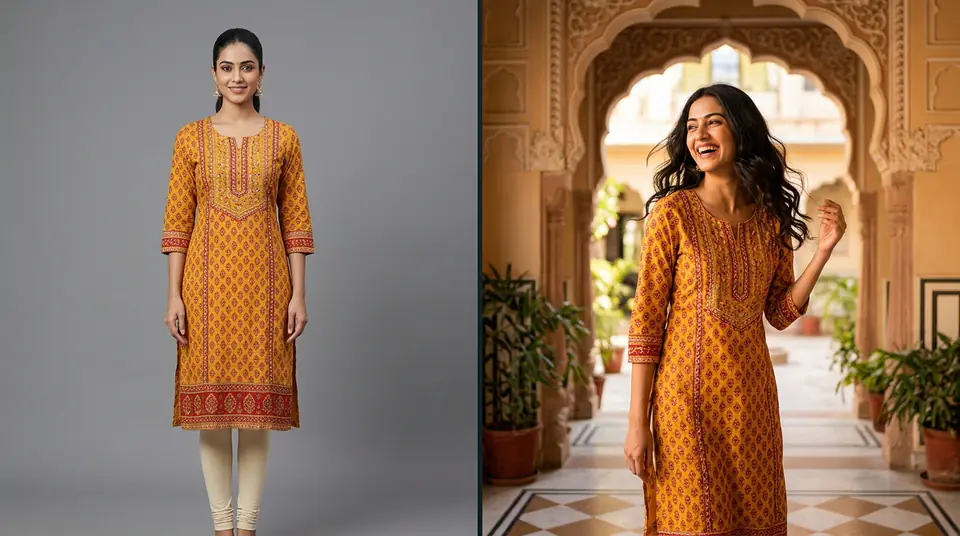
This is precisely where technology steps in to level the playing field. For years, the only solution to this `color variant photography` problem was throwing more money and time at traditional photoshoots. Now? Platforms like DrapifyApp have literally changed the game. You take one good photo of your garment (say, the black kurti). Then, you upload it. DrapifyApp's AI then generates professional, high-quality images of that exact same kurti in all its other colour variants. On identity-locked models. In ~3 minutes per photo. It’s like having a full studio and a team of photographers at your fingertips, but without the overhead.
I’m talking about getting high-resolution 2K or 4K output images for around ₹13-15 per photo. Compare that to even the lowest freelance photographer rates. And the best part? No need for reshoots if a colour doesn’t turn out right – the AI just generates another one, and failed shots are auto-refunded. You can suddenly have hundreds of visually stunning product images across all your `multi colour sku` for a fraction of the cost and time. This isn’t just about saving money; it’s about unlocking the true potential of your existing inventory and boosting your `fashion ecommerce conversion` rates.
Start small but smart. Pick your top 5 best-selling garments that have more than 3 unphotographed colour variants. Use DrapifyApp to generate photos for those missing variants first. Monitor your conversion rates and sales velocity on those specific SKUs. You'll see the impact almost immediately.