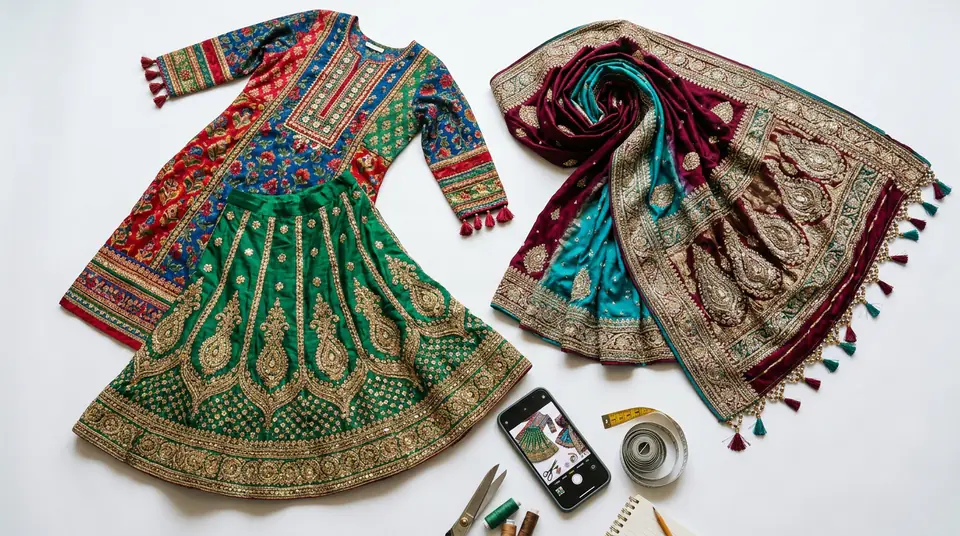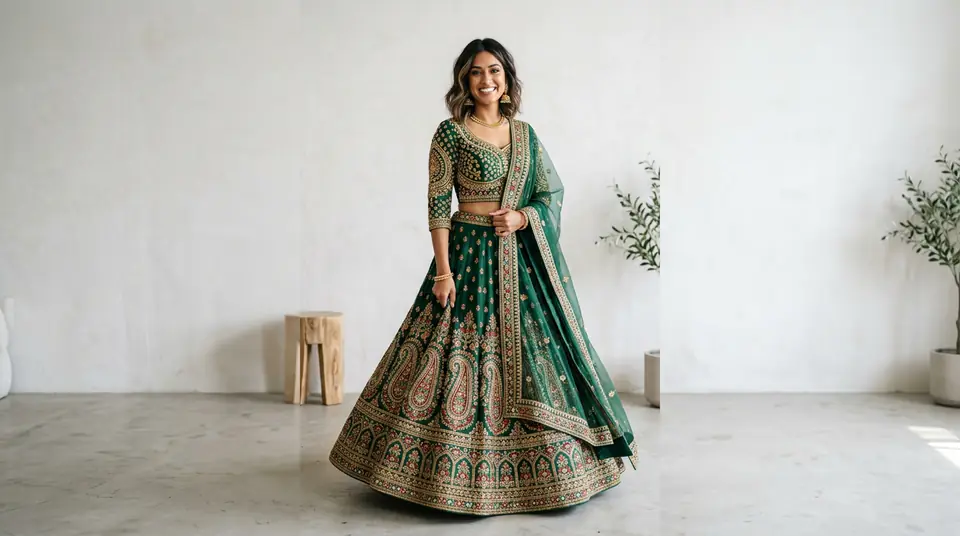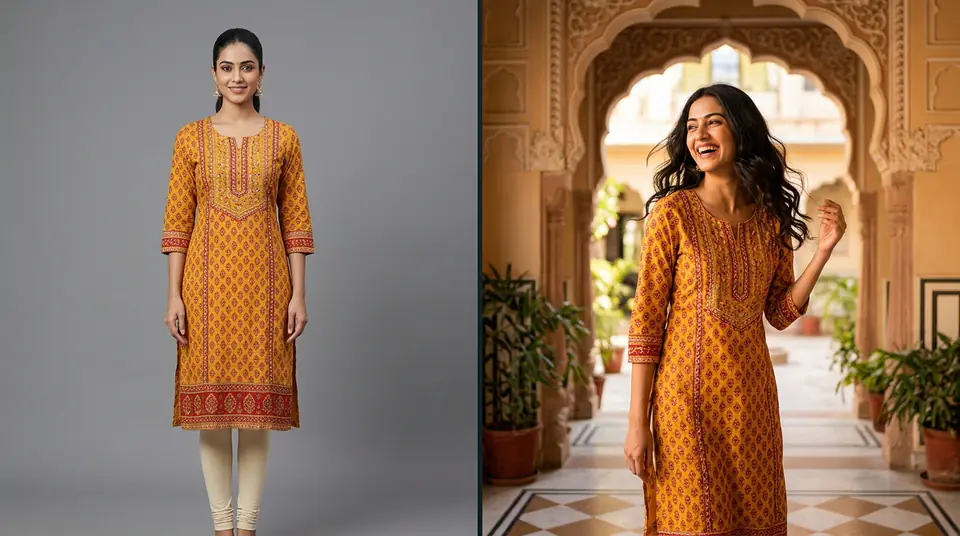
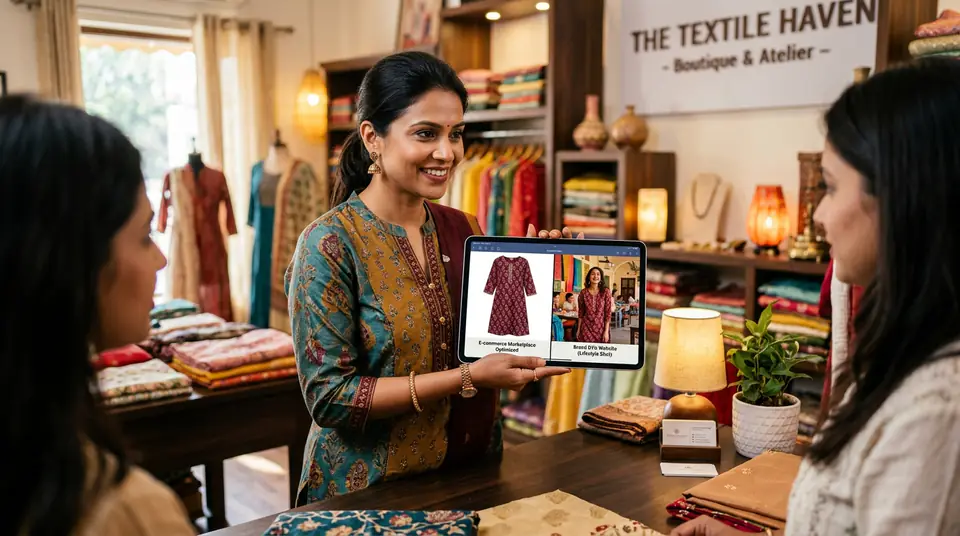
MYTH: 'One Photoshoot Can Serve Both My DTC Site and Myntra/Ajio.'
Oh, how I wish this were true! It'd save us all so much headache, time, and money, right? It's a natural thought. You’ve got a beautiful new collection of kurtis, a fantastic model, a great photographer. Why can't those same images just go everywhere? It feels efficient. It feels like smart budgeting. It made sense back when the online fashion landscape was simpler, a single storefront was enough.
But that's where the reality bites. Think of it like this: your DTC site is your store. You control the layout, the music, the scent, the vibe. Your images there are about brand storytelling, connecting with your customer, showing your unique aesthetic. Marketplaces like Myntra or Ajio? They're like bustling bazaars. Thousands of stalls, everyone shouting for attention. They have strict rules, tight spaces, and customers are there to compare and buy, often driven by price and quick search. Different stages, different performances, darling. You're not saving money by reusing photos; you're just spreading mediocrity and bleeding profits on two fronts.
70%
Myntra image rejections due to non-compliance
2-5x
More photos required per SKU for marketplace vs DTC
MYTH: 'Marketplaces Only Care About the Cheapest Possible Photos.'
This one's a persistent rumour, especially among new sellers in smaller towns. They see the sheer volume on Meesho or Amazon India and think, 'Just get any photo up there, as long as it's cheap.' It's easy to fall into that trap when margins feel tight and competition is cutthroat. The idea is to just list, list, list, and hope for the best, focusing on the product itself rather than how it's presented.
Here's the truth: marketplaces do care about photo quality, just not always in the way you might expect for your brand's Instagram. Their 'quality' is largely about compliance, consistency, and clarity. Can the customer clearly see the fabric, the stitching, the colour? Does it meet their strict white background requirements? Is it high resolution enough to zoom? Marketplaces have algorithms that penalize bad images, pushing your listing further down the search results. Good images reduce returns – something every marketplace tracks. It's not about being 'cheap'; it's about being right for the platform.
I had a client, a small textile exporter from Surat, who started selling directly on Myntra. He used his export catalogue photos – beautiful, artistic shots but on textured backgrounds, often with props. Myntra rejected 60% of his initial uploads. We reshot them, focusing purely on white backgrounds, standard poses, and crisp details. His listings finally went live, and his conversion rate on those specific products jumped 18% in the first month because customers could actually see what they were buying, without distraction.
15-20%
Conversion boost with compliant images on Myntra
30%
Average initial rejection rate for non-compliant images
Generate your own AI fashion photoshoot with Drapify — 50 free credits, no card required.
MYTH: 'My DTC Site Demands a Lavish, Expensive Lifestyle Shoot.'
Watching big brands on Instagram with their elaborate shoots in picturesque locales, you start thinking your small boutique needs to replicate that grandeur. The pressure to present an aspirational lifestyle is immense, and you believe only a high-budget shoot in Goa or Kerala with top models will cut it. It feels like the only way to establish credibility and a premium image online. And yes, good photography isn't free, but there's a huge difference between 'good' and 'lavish' money-pits.
Your DTC site definitely needs more than just product shots. It needs to tell your brand story, create an emotional connection. But 'lavish' doesn't automatically mean 'effective' or 'authentic'. Your customers, especially in India, often connect with relatable imagery. Think about a woman from Bengaluru or a college student in Delhi. They want to see themselves in your clothes. They might prefer seeing a kurti styled in a local café, or a saree draped for a family function, rather than an inaccessible, highly stylized editorial spread. Authenticity and relatability can often outperform pure glamour, especially when you're building a direct relationship. This is also where smart tech helps. We're now generating diverse scenarios and models that feel local and genuine for a fraction of the cost.
₹50,000 - ₹1.5 Lakh
Cost of a traditional lifestyle photoshoot day
₹13-15
Cost per AI-generated lifestyle image with DrapifyApp
MYTH: 'Customers Won't Notice if My Photos are Inconsistent Across Channels.'
You might think, 'Who has the time to cross-reference?' or 'My Myntra customer is different from my DTC customer.' It’s easy to compartmentalize, focusing solely on optimizing for each platform independently. The belief is that as long as each platform performs well in its own silo, customers won't bridge the gap. You upload one set of photos on Myntra and a slightly different vibe on your Shopify store, thinking no one really connects the dots.
Wrong. Oh, so wrong. Your customer is smart. They might discover your beautiful bandhani saree on Myntra, like it, and then search for your brand directly to see your full collection or check if you have better deals. If they land on your DTC site and the product looks completely different – different model, different lighting, a completely disjointed aesthetic – what does that tell them? It screams inconsistency. It erodes trust. It makes your brand look less professional, maybe even a little shady, like you're two different businesses. A unified, consistent brand identity, even with varied styles of photography, is crucial for building credibility and loyalty.
73%
Customers using multiple channels during shopping
5-10%
Increase in cart abandonment due to brand inconsistency
MYTH: 'AI Models Make My Brand Look Impersonal or Generic.'
This is a big one I hear from fellow boutique owners. There's a fear that AI means losing the human touch, that the photos will look robotic or fake, stripping away the unique charm of their designs. They worry about the perception of cutting corners, feeling that customers will somehow 'know' it's not a real model, thereby devaluing the product and the brand. It's a natural apprehension when new technology challenges traditional methods, especially in a creative field like fashion.
But let's be real: AI fashion photography, especially with platforms like DrapifyApp, has come a long, long way. It's not about replacing creativity; it's about empowering us to achieve incredible consistency, diversity, and sheer volume without the traditional overhead. You can get realistic models, varied poses, different skin tones, and even change backgrounds to suit your brand story – all from a single garment photo. Think about it: instead of spending days on a photoshoot, then weeks on editing, you can have a full catalogue of Myntra-compliant shots and lifestyle images for your DTC site in minutes. It's about smart scale and maintaining a cohesive look, something impossible with human models unless you've got bottomless pockets. I personally love how I can specify a South Indian model for a Kanchipuram saree, or a younger, trendier look for a modern kurti, all at a fraction of the cost and time.
For my Diwali collection last year, I had a sudden surge in demand for certain color variants of lehengas. Traditionally, this would mean recalling models, finding a studio, another half-day shoot, easily ₹20,000-₹30,000. Instead, I uploaded my existing product photos to DrapifyApp, selected the new colors, and had 20 high-quality model shots ready for my DTC site and Amazon listings within an hour. They looked natural, consistent with my brand, and most importantly, they sold out.
80%
Typical cost reduction with AI photography
90% faster
Catalogue creation speed with AI models