01.Your Outcome This Week: 500 New Listings
This isn't about pretty pictures; it's about efficient business. By the end of this week, you'll have photographed, processed, and listed 500 kurti SKUs. No studio, no models, no complex lighting. Just smart workflow and concrete results for your wholesale business. Total time investment for the full 500? After your initial setup, which itself takes under an hour, expect about 6-8 hours of focused work.
02.STEP 1: Audit Your Stock, Prioritize Your Shots
Don't just start shooting everything. That's a waste of time, money, and mental energy, especially when you're dealing with bulk inventory for marketplaces like Myntra or Ajio. You need to know exactly what to focus on first to maximize your impact during peak sales seasons. Take 30 minutes to lay out your priorities.
03.STEP 2: Build Your Zero-Studio Setup
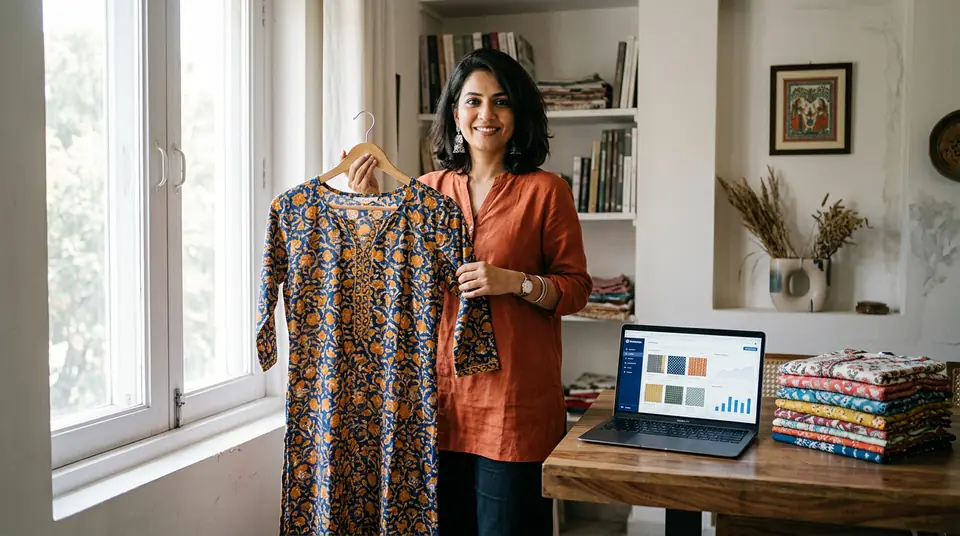
You don't need a fancy studio in Civil Lines for this. My first 10,000 kurtis? Shot right from a corner of my living room in Jaipur. A clean wall, good light, and a sturdy hanger. That’s your entire setup. Keep it minimal. This isn't about artistic photography; it's about clear, consistent product representation.
Position your kurti on the hanger, ensuring it hangs naturally. Smooth out any wrinkles. This part is boring, I know, but it saves headaches later. A well-presented garment shoots faster and looks better, even before any editing.
Generate your own AI fashion photoshoot with Drapify — 50 free credits, no card required.
04.STEP 3: Shoot The Hero Angle First, Then Variations
Consistency matters more than creativity when you're moving hundreds of garments. Buyers on Flipkart scroll fast. Your main image, the 'hero shot', must grab them instantly. Establish a rhythm and stick to it. This cuts down your per-garment shooting time drastically, sometimes to under 60 seconds per piece once you get going.
For flat lays, ensure you use masking tape to secure the garment in place for crisp, uniform shots. If it's a kurti with a flared hem or intricate border, a flat lay can sometimes show the detail better than a hanger shot. Switch between techniques as needed, but try to keep the style consistent across your catalogue.
05.STEP 4: Automate Post-Production with AI
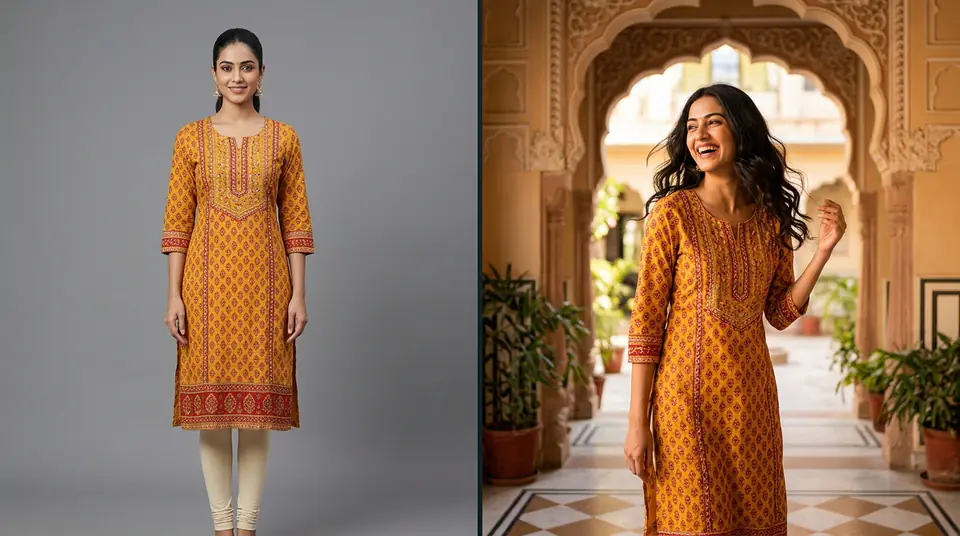
This is where you scale. Manually cutting out backgrounds, color correcting, or arranging models for 500 kurtis? Impossible if you want to keep costs down and sanity intact. We're running a business in Jaipur, not a high-fashion studio in Mumbai with unlimited budgets.
The beauty of a tool like DrapifyApp is its efficiency. For ~₹15 per photo, in about 3 minutes, you get a professional image. No reshoots for colour variants either – just change the hex code within the app. DrapifyApp even gives you 50 free credits to start, so you can test this workflow on your first few kurtis without spending a rupee. That kind of speed, for 500 garments, means you list faster, sell faster, especially important during a pre-Diwali rush.
06.STEP 5: Optimize Your Listings for Myntra and Flipkart
Good photos are half the battle. Your listing copy, titles, and tags seal the deal on marketplaces. Don't upload a beautiful image only to have it buried under generic descriptions. Think like your buyer; what are they searching for? Use keywords they'll type into the search bar.
07.STEP 6: Review Your Listings, Tweak Your Approach
You've done the work, now look at your numbers. What sold well? What didn't? This feedback loop isn't optional; it refines your process for the next 500 kurtis, and the 500 after that. It helps you identify which types of kurtis, photography styles, or descriptions resonate most with your target customer in cities like Delhi or Bengaluru.
This continuous improvement is how you stay competitive. Don’t get stuck in a rut. Your goal is to keep refining, keep learning, and keep selling. This zero-studio approach isn't just about saving money; it's about building a robust, scalable system for your wholesale fashion business.