Flipkart's Strict Standards: Why They Matter (and Trip You Up)
Flipkart product image guidelines aren't just arbitrary rules; they're designed to maintain a consistent shopping experience for millions of buyers, which in turn impacts your brand's credibility and sales. Unlike some other platforms, Flipkart often has stricter policies, especially around background, lighting, and model usage, leading to frustrating rejections for many sellers.
I’ve seen Surat garment wholesalers pull their hair out trying to get the same kurti catalogue approved on Flipkart that sailed through on Meesho and Myntra. The core issue? Details. Flipkart is very particular about pure white backgrounds, lighting uniformity, and the overall professional polish of the image. Even minor deviations can land your listing in limbo, costing you precious selling days, especially during peak seasons like Diwali or Eid.
For apparel, this means specific demands for how the product hangs, how models are posed, and even the amount of skin visible. It's a fine balance between showcasing your product effectively and adhering to every single clause in their seller policy document. Get it wrong, and you're paying for a reshoot or, worse, losing sales because your best-selling styles aren't even live.
Flipkart Product Image Guidelines: Traditional vs. AI Photoshoots
When creating product images for Flipkart, sellers generally choose between a traditional studio photoshoot or leveraging AI fashion photography platforms. Here's a head-to-head comparison to help you understand where each option stands against Flipkart's demands.
| Criterion | Traditional Photoshoot | AI Fashion Photography (e.g., DrapifyApp) | |||||||||||||||||||||
|---|---|---|---|---|---|---|---|---|---|---|---|---|---|---|---|---|---|---|---|---|---|---|---|
| Compliance with Flipkart Guidelines | Requires careful planning, experienced team, and post-production to match exact specs. High risk of human error or oversight. | Generates images optimized for pure white backgrounds, consistent lighting, and full product display, reducing manual correction. | Cost per Image (Model) | ₹300 - ₹1000+ per approved image (including studio, model, photographer, MUA, stylist, editing). | ₹9 - ₹35 per image (for 1K to 4K resolution) on DrapifyApp, with auto-refund for failed shots. | Speed & Turnaround | 1-2 days for shoot, 5-10 days for editing/delivery. Rush charges apply for faster delivery. | 3 minutes per image, with bulk processing options. Ideal for rapid collection launches. | Consistency (Model, Background, Lighting) | Hard to achieve perfect consistency across multiple shoots/models. Background variance common without strict control. | Ensures identity-locked models and pure white backgrounds across all shots. Lighting is digitally controlled and uniform. | Color Variants | Each color variant needs to be shot separately, significantly increasing costs and time. | Can generate new color variants from a single garment photo without reshooting, saving time and money. | Flexibility & Iteration | Limited post-shoot flexibility. Changes often require costly reshoots or extensive editing. | Easy to generate multiple poses, backgrounds (within white-background limits for Flipkart), and model options rapidly. | Setup & Logistics | High logistical burden: booking studio, models, team, managing garments, travel, etc. | Upload a single flat-lay or hanger photo. Zero logistics beyond your own product photography. | Intellectual Property | Negotiated usage rights with models; potential for future costs or restrictions. | Full commercial rights to generated images, no ongoing model fees or legal ambiguities. |
80%
potential cost reduction with AI for catalogue shots
3 minutes
time to generate an AI image on DrapifyApp
2000x2000px
Flipkart's preferred image resolution
The Cost Equation: Studio Shoot vs. AI Photos for Flipkart
For many apparel sellers in India, especially those in Jaipur or Delhi, the cost of traditional photography for Flipkart listings can be a significant bottleneck. A typical catalogue shoot for 50-100 SKUs with models can easily run you ₹40,000 to ₹1,00,000 for a single day, and that's before accounting for reshoots or missed opportunities from delayed listings.
When I was scaling my first brand, we'd budget around ₹500-₹800 per approved model shot for Myntra, and Flipkart often required similar quality. This includes model fees (a good model in Mumbai charges ₹10,000-₹20,000 a day), photographer's charges, make-up artist, stylist, studio rental, and then the extensive post-production required to hit that pixel-perfect white background and consistent lighting. Any minor error means more rounds of editing, which translates to more billable hours.
AI fashion photography, like DrapifyApp, fundamentally changes this math. You're looking at a direct cost of ₹9 per 1K resolution image, ₹25 for 2K, and ₹35 for 4K. For a typical Flipkart listing, 2K resolution is often more than sufficient, putting your cost at a fraction of a traditional shoot. This drastic reduction in per-image cost allows you to photograph every single SKU and every single color variant you carry, not just the best-sellers you can afford to shoot.
While AI is powerful, it's not magic. If your initial garment photo is low-resolution, poorly lit, or has creases, the AI output might struggle to deliver the perfect image. Always start with a clear, well-lit flat-lay or hanger shot of your product to get the best results for your ecommerce product photography.
Speed and Scale: Meeting Flipkart's Demands for New Collections
The fashion industry runs on seasons, festivals, and trends. Missing a festive window like Diwali because your catalogue isn't ready is a profit killer. Traditional photoshoots have a fixed, often slow, turnaround time. Booking models, studios, shooting, and then waiting for editing can easily take 2-3 weeks. For a fast-moving brand, that's an eternity.
I've seen brands in Tirupur with hundreds of new knitwear designs struggle to get their full collections online before the season ends. You're constantly playing catch-up, prioritising a few hero SKUs and leaving many others unpublished, or pushing them live with sub-par imagery just to meet deadlines. This isn't scaling; it's survival.
With AI tools, the concept of 'turnaround time' is almost obsolete. You upload your garment photos, select your preferred models (DrapifyApp allows for identity-locked models across poses, ensuring brand consistency), and within minutes, your images are ready. This capability fundamentally changes how you approach inventory. Instead of shooting 100 designs and hoping, you can shoot all 500 you have, test them on Flipkart, and react to sales data immediately. This rapid iteration is crucial for increasing sales on Amazon India fashion, Myntra, and especially Flipkart.
This speed is particularly impactful for brands that need bulk catalogue photography for ecommerce India. Imagine being able to photograph an entire collection of lehengas or sarees in an afternoon, rather than tying up a studio for days or weeks.
Consistency and Compliance: The Headache of Marketplace Updates
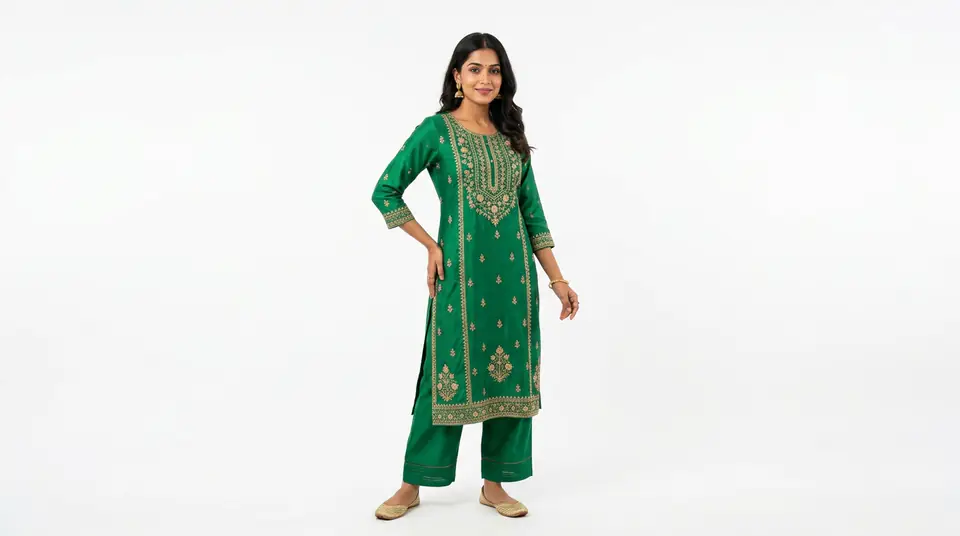
Maintaining consistency across hundreds, if not thousands, of listings on Flipkart is a constant battle. Their algorithms favour listings with uniform presentation. This means every product on a pure white background, models consistently lit, and poses that showcase the garment clearly.
I often tell sellers that the same file that passed on Amazon India or even Myntra might get rejected by Flipkart because their background detection is particularly strict, or their model guidelines differ slightly. They don't want watermarks, text, or even too much shadowing. If you're working with different photographers or trying to DIY, variations creep in easily. Then Flipkart updates its guidelines, and suddenly half your catalogue needs a refresh.
AI platforms are built for this kind of consistency and compliance. They can generate a standard pure white background (RGB 255, 255, 255) every single time, ensuring every image meets that critical Flipkart requirement. Furthermore, with AI, you can ensure the same model presents your entire collection, maintaining a strong, cohesive brand identity. This also makes adapting to new Myntra image guidelines 2026 or Flipkart's future updates much simpler; you just re-run your existing garment images through the updated AI engine.
Think about colour variants: if you sell a kurti in eight colours, do you really shoot all eight on a model in a studio? Most don't, which means lost sales for those unlisted colours. AI tools allow you to generate color variant photography for every single SKU and shade from a single master image, ensuring full compliance and maximum product visibility.
Who Should Pick Which for Flipkart Product Images?
The choice between traditional and AI photography for your Flipkart listings depends heavily on your brand's specific needs, budget, and scale. Both have their merits, but for Flipkart's stringent guidelines, one often has a clearer advantage.
Verdict: My Recommendation for Flipkart Sellers
Having scaled multiple Indian fashion brands past ₹1 crore/month, I've learned that consistent, high-quality visuals are non-negotiable for marketplace success. For meeting Flipkart product image guidelines efficiently and affordably, especially for apparel, AI fashion photography is, in my experience, the clear winner for 90% of sellers.
The sheer speed, cost-effectiveness, and built-in consistency that platforms like DrapifyApp offer directly address the biggest pain points sellers face with Flipkart's strict requirements. You're not just getting photos; you're getting photos engineered to pass Flipkart's quality checks and convert buyers, without the logistical nightmare or the massive upfront investment of a traditional studio.
If you're launching a new collection and need 200 model shots approved on Flipkart next week, a traditional studio will bleed you dry or fail you on time. DrapifyApp can get those done, ready for upload, in a few hours for a few thousand rupees. That's a difference measured in lakhs of rupees of sales, not just photography costs. I keep recommending AI photography to sellers because it lets them focus on what they do best: sourcing and selling great fashion, not endlessly fighting image rejections.