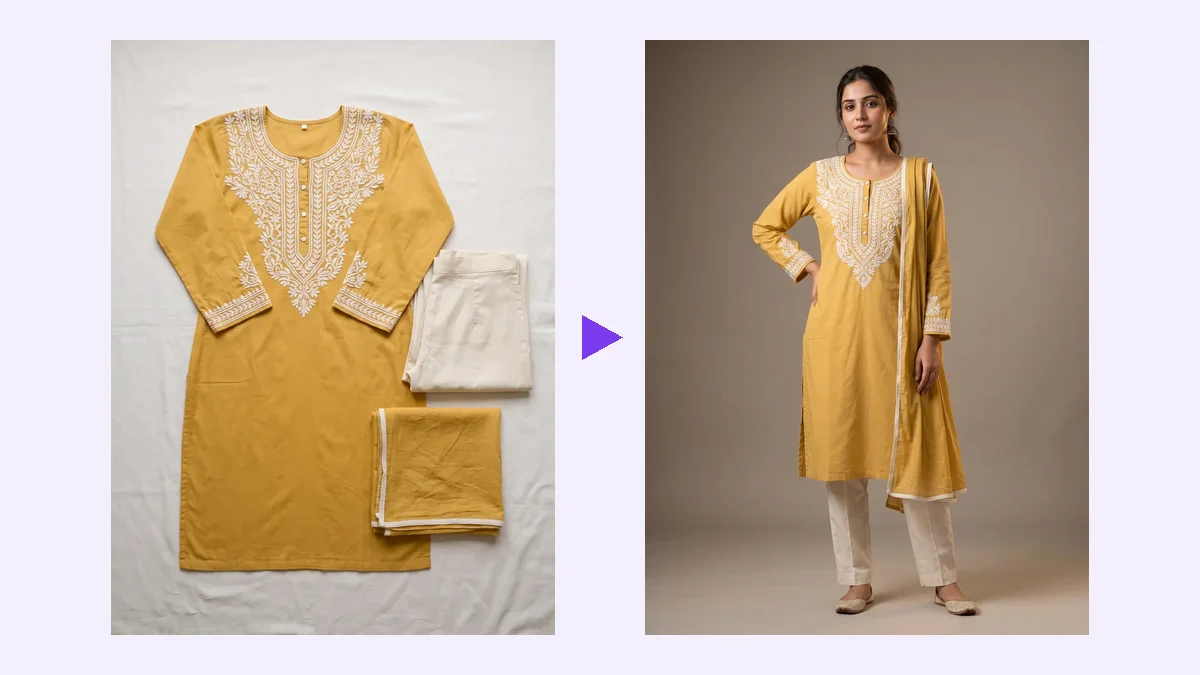
List every cost per order
The selling price has to cover more than the garment. For each order, write down:
- Product cost: what you pay to buy or make the piece.
- Packaging: polybag, tape, label.
- Shipping: what you pay the marketplace or courier for your weight slab and zone.
- Returns allowance: your return rate x the average cost of one return.
- Ad cost per order, if you advertise: ad spend divided by orders.
- Overheads per order: rent, internet, salaries, divided by monthly orders.
- Percentage costs: marketplace commission and payment fee, if any.
Fee rates change, so take them from your marketplace's current rate card. All numbers below are examples to show the method.
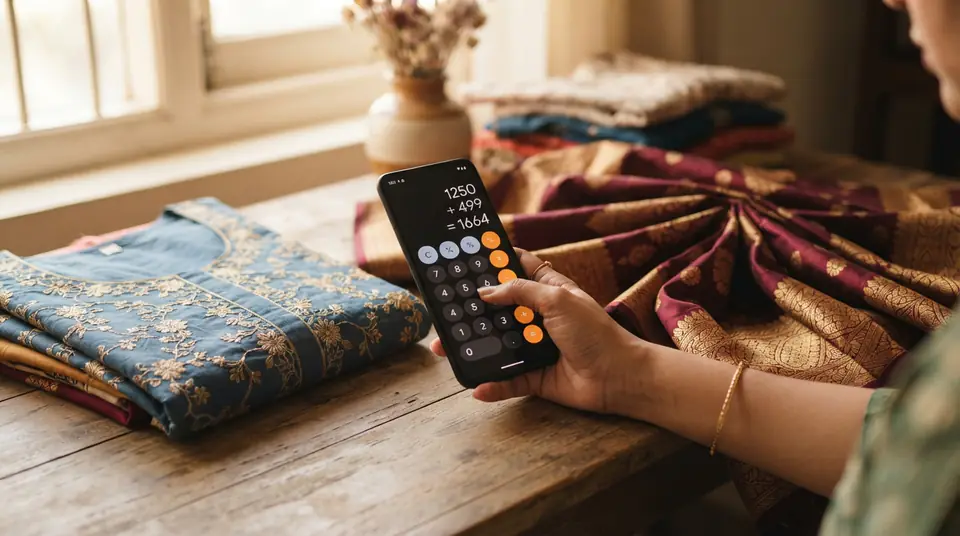
The pricing formula
Costs that are a fixed rupee amount go on top. Costs that are a percentage of the selling price go in the divisor, because they grow with the price.
If you add commission as a fixed 12% of cost instead, you will underprice, because 12% is charged on the selling price, not on your cost.
Example 1: a kurti bought at ₹150
Hypothetical numbers: packaging ₹5, shipping ₹70, returns allowance ₹15, ad cost ₹30, overheads ₹10. Commission 12%, payment fee 2%, target margin 10%.
| Step | Working | Result |
|---|---|---|
| Fixed costs | 150 + 5 + 70 + 15 + 30 + 10 | ₹280 |
| Divisor | 1 - 0.12 - 0.02 - 0.10 | 0.76 |
| Selling price | 280 / 0.76 | ₹368.42, round to ₹369 |
| Check at ₹369 | Commission 44.28 + fee 7.38 + fixed 280 = 331.66 | Profit about ₹37 (10%) |
A flat "double the cost" price of ₹300 would leave 300 - 280 - 42 = -₹22 once the same fees are taken out. That is the gap the formula closes. If ₹369 is above what competing listings charge, reduce the ad cost or shipping weight first, or accept a lower margin.
Example 2: a saree bought at ₹1,000
Hypothetical numbers: packaging ₹15, shipping ₹120, returns allowance ₹75, ad cost ₹100, overheads ₹20. Commission 15%, payment fee 2%, target margin 15%.
| Step | Working | Result |
|---|---|---|
| Fixed costs | 1,000 + 15 + 120 + 75 + 100 + 20 | ₹1,330 |
| Divisor | 1 - 0.15 - 0.02 - 0.15 | 0.68 |
| Selling price | 1,330 / 0.68 | ₹1,955.88, round to ₹1,956 |
| Check at ₹1,956 | Commission 293.40 + fee 39.12 + fixed 1,330 = 1,662.52 | Profit about ₹293 (15%) |
Higher-value items carry larger absolute fees and returns losses, so the allowance and ad cost matter more here.
Returns: work out your own allowance
Apparel returns can be high, and the figure depends on your category, size range and listing quality. Do not borrow a percentage from a blog. Use your seller panel's last three months: returned orders divided by total orders gives your return rate, and the average cost of a return is the lost shipping both ways plus any damaged or unsaleable stock.
Accurate size charts, clear photos of fabric and colour, and honest descriptions help buyers choose correctly. See how to take photos of clothes for selling online.
Check the price before you list
- Run the numbers in the ecommerce profit calculator or Meesho profit calculator with your actual fee card.
- Add GST handling separately: ask your accountant whether the price is GST-inclusive. See GST on clothes for the current slabs and the price threshold per piece.
- Compare with three similar listings. If you are far above them, find the cost to cut instead of the margin to cut.
- Re-check every few months, since fees and shipping rates change.
Photography is a cost you can control
Photos are a per-style cost. A studio shoot is priced per vendor, so get quotes. DrapifyApp charges 9 credits for a 1K photo and 25 for 2K; packs start at ₹199 and credits never expire. A first photoshoot takes about 3 minutes, and the first 2K photo is free. Put your own per-style photo cost into the overheads line when you price.