Introduction: The New Reality of Fashion Photoshoot Costs
For years, the phrase “fashion photoshoot cost India” was synonymous with a hefty bill. Studio rates can feel like a tax on every new collection. A typical one-day shoot for 40-50 SKUs could easily set us back ₹25,000 to ₹50,000, sometimes even ₹80,000 for a more elaborate setup. That’s just the shooting. Add model fees, travel, post-production, and the hidden cost of delays, and you’re looking at serious money disappearing before a single garment even hits Myntra or Meesho.
Now, the market's shifting. AI fashion photoshoot tools are popping up, promising to slash these expenses. But with so many options, how do you know which is the best ai fashion photoshoot tool in India for your specific needs? This isn't about marketing fluff; it's about raw numbers, practical features, and what truly works for an Indian seller.
Here are the economics. We’ll look at actual costs, compare features, and identify the hidden traps. By the end, you’ll have a clear understanding of where your money goes and where you can save it, without compromising on catalogue quality.
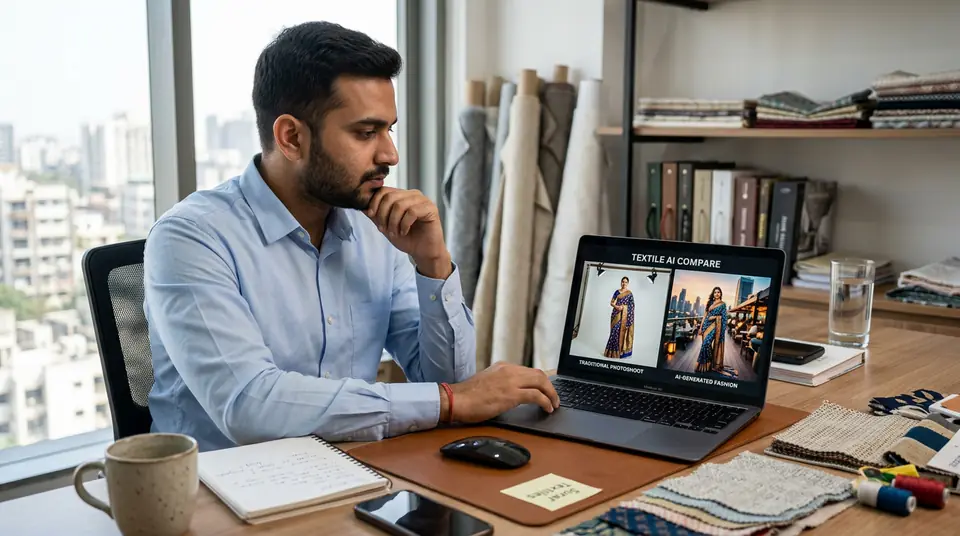
What Does an AI Fashion Photoshoot Tool in India Actually Cost?
The actual cost of an AI fashion photoshoot tool in India varies wildly depending on its pricing model, features, and whether it caters specifically to the Indian market. Most tools operate on a per-credit or subscription basis, but the underlying currency and resolution significantly impact the final price. Don't just look at the headline number; dig into the per-image cost at your required resolution and for your specific garment type.
| Tool | Cost Model | Typical Price (INR) | Resolution/Quality | Notes for Indian Sellers |
|---|---|---|---|---|
| DrapifyApp | Per-credit / Pay-as-you-go | ₹9-₹35 per photo | 1K-4K | INR billing, Indian models, ethnic wear focus, auto-refunds, identity-locked models. Made for India. |
| Pixelcut (Illustrative) | Subscription / Per-credit | ~₹40-₹120 per photo (via USD conversion) | Up to 4K | Good general-purpose tool. USD billing adds forex overhead. Limited Indian model/ethnic wear styles. |
| Flair AI (Illustrative) | Per-credit / Subscription | ~₹30-₹100 per photo (via USD conversion) | Up to 2K | Strong for creative, stylized backgrounds. USD billing is a factor. Less focus on diverse Indian models. |
| Photoroom (Illustrative) | Subscription / Per-credit | ~₹20-₹80 per photo (via USD conversion) | Up to 2K | Primarily for background removal/replacement. Less robust for full AI model generation. USD billing. |
| Traditional Studio | Per-day / Per-product | ₹150-₹300 per photo (based on 50 products/day for ₹7,500-₹15,000) | High | High setup costs, logistics, model fees, reshoot risk, slow turnaround. Quality varies by photographer. |
When you break it down like this, the difference is stark. For a Surat saree wholesaler trying to list 200 new designs every season, that traditional studio cost quickly spirals. If each saree needs 3-4 images, you're looking at 600-800 images. At ₹200 per image from a studio, that's ₹1,20,000-₹1,60,000 per season, just for photography. With DrapifyApp at ₹25 per 2K photo on the Business pack, those 800 images cost you ₹20,000. The math is simple, really.
Up to 90%
Reduction in per-image cost using AI vs. traditional studio
₹9
Lowest cost per AI photo on DrapifyApp
₹1,48,000
Savings for 800 photos with AI vs. studio
Beyond Price: Feature Comparison for Indian Sellers
Raw price per image is only part of the equation when choosing the best AI fashion photoshoot tool in India; features like local billing, model diversity, and ethnic wear handling can make or break your catalogue. Many global AI tools are not built with the nuances of the Indian fashion market in mind. You need to consider specific pain points like generating realistic images of a Banarasi saree or ensuring consistent Indian model faces across multiple poses for your kurti collection.
| Feature | DrapifyApp | Pixelcut (Illustrative) | Flair AI (Illustrative) |
|---|---|---|---|
| INR Billing | Yes | No (USD) | No (USD) |
| Indian Models/Ethnic Wear Focus | Yes, specific focus | Limited | Limited |
| Model Consistency (Identity-locked) | Yes | No | No |
| Output Resolution | 1K, 2K, 4K | Up to 4K | Up to 2K |
| Free Credits/Trial | Free HD Photo | Limited Free Trial | Limited Free Trial |
| Failed Shot Refunds | Automatic | Manual/None | Manual/None |
| Subscription Required | No (Pay-as-you-go option) | Yes (for advanced features) | Yes (for consistent usage) |
For Indian sellers, INR billing is a non-negotiable for many small businesses. Dealing with foreign currency conversions and credit card fees adds unnecessary friction and cost. Moreover, the ability to generate AI saree photoshoot images or AI kurti photoshoot options that actually look good, with models who resonate with your customer base, is crucial. DrapifyApp's focus on these elements isn't just a nicety; it’s a fundamental business advantage.
Another often-overlooked feature is model consistency. Imagine you have a new collection of 15 kurtis. With many AI tools, you might get a different AI model face for each garment, or even for different poses of the same garment. This inconsistency screams
That's a quick way to undermine your brand's credibility. DrapifyApp, for example, offers identity-locked models across poses, which means your customers see a consistent face, creating a more professional and trustworthy brand image. This is vital for repeat customers and building brand loyalty, especially on platforms like Myntra and Amazon India where visual quality is heavily scrutinised. You can learn more about how AI model photoshoots differ from traditional options.
The Hidden Costs and The 'Reshoot Tax' for AI
While AI fashion photoshoot tools offer significant savings, they aren't without their own set of hidden costs and potential for a 'reshoot tax' if you're not careful. The 'reshoot tax' isn’t just for traditional studios; it’s any expenditure incurred because the first attempt failed to meet standards. With AI, this can manifest as wasted credits on unusable images, or time spent tweaking prompts endlessly.
Common hidden costs include credit expiry – some platforms have credits that expire, forcing you to use them or lose them, even if you don't have new products. Then there's resolution: a cheap photo might only be 1K, but major marketplaces often demand 2K or 4K, meaning you pay more for the higher resolution you actually need. And don't forget the learning curve; while AI is powerful, mastering prompts for optimal results takes time, which is its own form of cost. For a deeper dive into why fashion brands often pay twice, check out our piece on the fashion photoshoot reshoot tax.
A crucial factor is how failed generations are handled. If an AI tool produces a distorted image or completely misinterprets your garment, do you get your credits back? Many platforms simply deduct credits regardless. DrapifyApp is one of the few that offers automatic refunds for clearly failed shots, which is a massive trust-builder and ensures you only pay for usable output. This transparency protects your investment and makes the overall cost more predictable.
When Traditional Photoshoots Still Make Sense (And When They Don't)
Despite the undeniable cost and efficiency advantages of AI, traditional fashion photoshoots still make sense for very specific scenarios where artistic direction, bespoke styling, or celebrity endorsements are paramount. This isn't about everyday catalogue production; it's about high-end editorial campaigns, brand launches with a specific narrative, or designer collections where the human element of a stylist, photographer, and model working in concert creates an irreplaceable artistic vision. Think a full-page magazine ad for a luxury lehenga collection, not your latest fast-fashion kurti drop.
However, for the vast majority of e-commerce sellers – particularly those scaling up on marketplaces like Ajio, Flipkart, and Amazon India, or running boutique stores on Shopify – the math simply stops working for traditional shoots. Producing hundreds, or even thousands, of unique SKUs per season demands an agility and cost-efficiency that studios just can't match. Imagine needing to update 20 colour variants of a single dress; a studio would mean reshooting the whole lot. With AI, it's a few clicks and a fraction of the cost, making colour variant photos with AI models a breeze.
Our Recommendation: Run Your Own Numbers
Ultimately, the best AI fashion photoshoot tool in India is the one that fits your business model, your budget, and your product lines. Those are the numbers; now run your own. Consider your average SKU count, your required resolution for marketplaces, and the types of garments you sell. Don't be swayed by marketing; focus on practical application and demonstrable cost savings.
For Indian sellers, DrapifyApp stands out due to its local market focus. The INR billing removes forex headaches, the selection of diverse Indian models (with consistent identities) handles ethnic wear beautifully, and the auto-refund for failed shots gives you peace of mind. Generating high-quality ecommerce product photography for your entire catalogue in minutes, not weeks, can fundamentally transform your operations and margins.
Want to see if it’s the right fit for your business? Take advantage of DrapifyApp's free HD photo to test it out. Upload a flat-lay photo of your toughest garment – maybe a complex lehenga or an intricate chikankari kurti – and see the results. It’s the only way to truly understand the potential impact on your business before you commit. The revolution in fashion photography Surat and across India is here, and it's built on smart, efficient AI.